Cormac McCarthy’s writing is steeped in a brutal, unrelenting vision of existence, and one that, at times, echoes the nihilistic and power-driven philosophy of Friedrich Nietzsche. Nowhere is this more evident than in Blood Meridian’s Judge Holden, a figure who embodies war as both a cosmic principle and an existential necessity. Like Nietzsche’s Übermensch, the Judge transcends conventional morality, embracing violence, will to power, and the eternal recurrence of conflict as the only true laws of the world. His philosophy dismantles the illusions of justice, mercy, and meaning, leaving in their place a vision of existence governed solely by domination and survival. In this way, McCarthy’s novel becomes not just a meditation on historical bloodshed, but a terrifying philosophical reckoning, one in which Judge Holden stands as the prophet of an indifferent, amoral universe.
Judge Holden is not merely a character in Blood Meridian: he is a force of nature, a prophet of violence, and the harbinger of an eternal war that predates humanity itself. For, “War was always here. Before man was, war waited for him.”
His words are not idle musings but declarations of an unchanging, inescapable reality, one in which free will is an illusion and destruction is the only constant. In his world, war is not a choice but a necessity, a cosmic order that men either submit to or are crushed beneath. Through a series of choice monologues, the Judge lays bare a vision of the universe stripping away the comforting fictions of morality, progress, and human exceptionalism. He speaks of war as something sacred, of existence as a fever dream, of fate as a thing already written. To understand the Judge is to confront a truth both horrifying and undeniable – that violence is not an aberration, but the foundation upon which all things rest.
“It makes no difference what men think of war, said the judge. War endures. As well ask men what they think of stone. War was always here. Before man was, war waited for him. The ultimate trade awaiting its ultimate practitioner. That is the way it was and will be. That way and not some other way.”
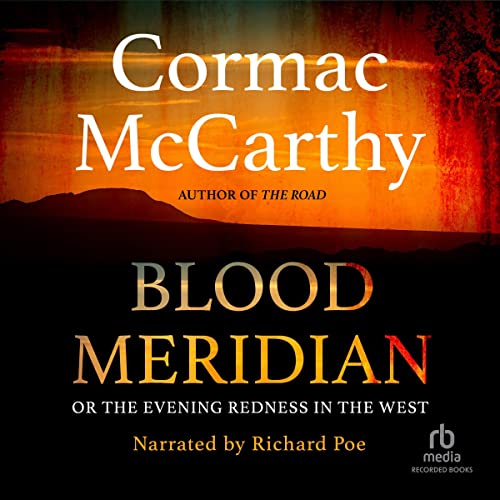
To Judge Holden, war presents an absolute force, both self-justifying and all-encompassing, needing no rationale beyond itself. It is not merely conflict but the ultimate form of divination, revealing truth by testing wills within a larger, unknowable order that selects the victor. War is the highest expression of power, a unifying principle that strips away illusion and exposes existence as a relentless struggle. In declaring “War is god,” the Judge reduces morality and justice to mere illusions, asserting that violence is the only true law. This passage encapsulates Blood Meridian’s vision of history and human nature as governed solely by force, where war does not just determine fate: it is fate.
“This is the nature of war, whose stake is at once the game and the authority and the justification. Seen so, war is the truest form of divination. It is the testing of one’s will and the will of another within that larger will which because it binds them is therefore forced to select. War is the ultimate game because war is at last a forcing of the unity of existence. War is god.”
Judge Holden emerges from these passages as an entity beyond morality, beyond time – a force that embodies the absolute inevitability of war and fate. He speaks with the authority of one who has transcended human limitations, rejecting the illusion of free will and asserting that every man’s path is fixed, no matter his choices. Destiny is not merely a road but a vast and all-encompassing force, containing within it every possibility, even opposition. The desert, a place of ruin and revelation, mirrors this reality: immense, indifferent, and ultimately empty. Those who traverse it may believe themselves to be agents of their own fate, but they are merely walking toward an end that was always theirs.
“A man seeks his own destiny and no other, said the judge. Wil or nill. Any man who could discover his own fate and elect therefore some opposite course could only come at last to that selfsame reckoning at the same appointed time, for each man’s destiny is as large as the world he inhabits and contains within it all opposites as well. The desert upon which so many have been broken is vast and calls for largeness of heart but it is also ultimately empty. It is hard, it is barren. Its very nature is stone.”
For the Judge, war is not a transient condition but the fundamental principle of existence. It is not shaped by human opinion, nor does it require justification; it simply is, as enduring and immutable as stone. The Judge does not see war as an aberration but as the purest expression of life, the ultimate game in which will is tested, fate is revealed, and history is written with blood. It is the great selector, the divine force that determines who shall remain and who shall vanish into the void. War is god.
“This is the nature of war, whose stake is at once the game and the authority and the justification. Seen so, war is the truest form of divination. It is the testing of one’s will and the will of another within that larger will which because it binds them is therefore forced to select. War is the ultimate game because war is at last a forcing of the unity of existence. War is god.”
The idea of the “dance” recurs throughout his philosophy, a ritual in which only the true warrior can partake. Most men, blinded by sentimentality or false ideals, are incapable of embracing war fully. They are false dancers, condemned to irrelevance. But the one who has descended into the abyss, who has not only witnessed horror but accepted it as truth, is the only one fit to remain upon the stage. The Judge sees himself as this final dancer, the only being who truly understands the nature of existence. All others will fade into the nameless dark, stepping down before the floodlamps, while he alone continues, eternal and unchallenged.
“The truth about the world, he said, is that anything is possible. Had you not seen it all from birth and thereby bled it of its strangeness it would appear to you for what it is, a hat trick in a medicine show, a fevered dream, a trance bepopulate with chimeras having neither analogue nor precedent, an itinerant carnival, a migratory tentshow whose ultimate destination after many a pitch in many a mudded field is unspeakable and calamitous beyond reckoning.
The universe is no narrow thing and the order within it is not constrained by any latitude in its conception to repeat what exists in one part in any other part. Even in this world more things exist without our knowledge than with it and the order in creation which you see is that which you have put there, like a string in a maze, so that you shall not lose your way. For existence has its own order and that no man’s mind can compass, that mind itself being but a fact among others.”
This vision of the world is one of radical, cosmic nihilism. The order that men perceive is an illusion, a thread they weave to give themselves direction, but in truth, the universe is vast, unknowable, and indifferent to human reason. Within this boundless chaos, only those who understand its true nature – who accept that anything is possible, that morality is a construct, that war is the ultimate law – can rise above the rest. Judge Holden is fate embodied, the final authority over who may remain in the dance and who must disappear into the eternal night.
“All other trades are contained in that of war. Is that why war endures? No. It endures because young men love it and old men love it in them. Those that fought, those that did not.”
Judge Holden embodies Nietzsche’s Übermensch in its purest and most terrifying form. He is not shaped by history but rather shapes it, acting as an unrelenting force of will. The Kid, by contrast, is caught in an existential limbo, drawn to violence yet unable to fully surrender to it. Unlike the Judge, who transcends all notions of guilt and conscience, the Kid hesitates, clinging to remnants of human connection and moral uncertainty. This tension renders him a tragic figure – one who recognises the brutal reality the Judge preaches but lacks the conviction to embrace or subvert it.
The novel’s final encounter between the Judge and the Kid underscores this contrast. The Judge, eternal and invincible, continues his dance, declaring himself the master of all. The Kid, despite his survival, is ultimately unfit to stand alongside him. He is not strong enough to become the Übermensch but unwilling to fully dissolve into the abyss either. In Nietzschean terms, he remains a transitional figure, one who resists the Judge’s will to power but lacks the force to impose his own. His fate is uncertain, his legacy erased, while the Judge endures, dancing on.
“I tell you this. As war becomes dishonored and its nobility called into question those honorable men who recognize the sanctity of blood will become excluded from the dance, which is the warrior’s right, and thereby will the dance become a false dance and the dancers false dancers. And yet there will be one there always who is a true dancer and can you guess who that might be?
You aint nothin.
You speak truer than you know. But I will tell you. Only that man who has offered himself up entire to the blood of war, who has been to the floor of the pit and seen horror in the round and learned at last that it speaks to his innermost heart, only that man can dance.
Even a dumb animal can dance.
The judge set the bottle on the bar. Hear me, man, he said. There is room on the stage for one beast and one alone. All others are destined for a night that is eternal and without name. One by one they will step down into the darkness before the floodlamps. Bears that dance, bears that don’t.”
In conclusion, the world of Blood Meridian, and perhaps, most likely, our world too, is one without redemption where history is written in blood and where the only law is that of entropy. Judge Holden, in all his terrible wisdom, does not merely revel in this reality – he defines it. His philosophy is one of absolute determinism, a world where men love war, not because they are forced to, but because it is in their nature. He teaches that the universe is a spectacle of endless conflict, an itinerant carnival of chaos marching toward an unspeakable and inevitable reckoning. In his final, cryptic moments, he declares himself eternal, never sleeping, never dying – a reminder that war, suffering, and domination are not transient horrors, but the very fabric of existence itself. Whether he is man, demon, or something beyond comprehension, the Judge endures, dancing long after all the other dancers have fallen into void.
BOSTKTB,
HTBLOF.
– D.


 Mithraic Magazine
Leave a comment