If you’ve not heard Trivax’s The Great Satan yet, I think you need to reconsider the next 42 minutes of your time and rectify this error. Released this year, The Great Satan comes out swinging standing at the intersection between black and death metal and doesn’t miss a beat.
At times reminding me of Watain’s Lawless Darkness, and at other times reminding me more of Obscura’s Cosmogenesis (looking at you, passage 4m30s into Daemon’s Melancholia), this album defies both the listener’s and genre’s expectations by going above and beyond to create something truly unique to themselves. This album isn’t following a wave, it is creating one.
If you aren’t aware already, Trivax are a UK-based extreme metal band with roots in the Middle East, particularly Iran, where the project was first conceived under oppressive conditions that made playing metal music more than just a dangerous act of defiance. Now established in the UK, Trivax has carved out a unique voice in the European extreme metal scene, turning defiance and perseverance into a powerful artistic statement.
Today I’m speaking with Shayan to talk about The Great Satan, metal in the Middle East, and what the future holds for the project.
Shayan also has his own YouTube channel where he does a lot of what we do here (i.e. speaking to people he finds interesting from within the extreme metal community and beyond.) So if you’re looking for some extreme metal interviews in a more visual format, make sure to check out his work at Iblis Manifestations after we’re done here!
Trivax Interview (with Shayan, by D)
Appreciate your time today, Shayan! I always like to start by asking, in your own words, what is Trivax, and how did this project begin? I ask this question a lot, but I’m confident Trivax’s story will be one of the wildest ones we’ll hear!
Hey there, thanks for the interview! The definition is in the meaning of the name that we gave it, which is a storm. It’s a storm that challenges frequency notions, ideas, and even culture on a broader level – All done within the guys of Eastern Death Magick.
It all started in Iran back in the spring of 2009 when I first formed the band with my friend L.A. of Lavizan Jangal, although I had technically already started prior to this as a solo project. It then returned to a solo project after a while, then reformed with a full band lineup in 2010 in Tehran, where we had an actual drummer. Quite a rare case at that time.
Later, I moved to the UK for the sole purpose of continuing TRIVAX and reformed the band with a British lineup.
The drummer from those days still plays with us today, almost 14 years later.
The rest is history, as they say.

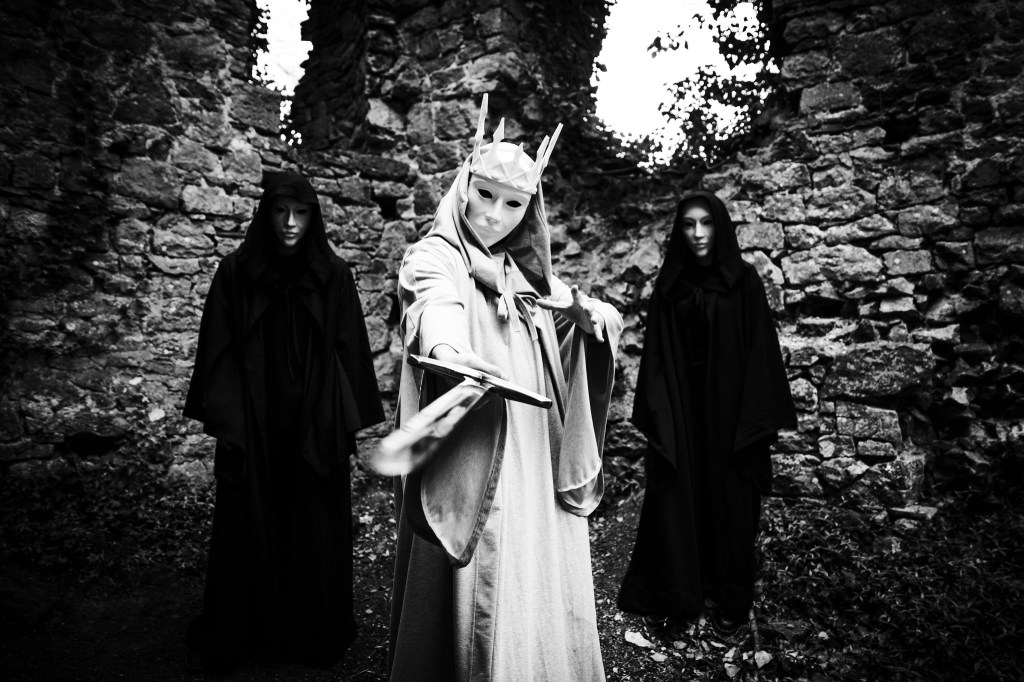
Image credit: Necroshorns
The Great Satan is not long released and it’s sounding excellent. Was it recorded at Priory Recording Studios / mixed at Ritual Studios? How did you find the recording experience working with both studios?
Really good. Sam at Ritual Sound did the mixing of our previous album “Eloah Burns Out” back in 2019, although the album didn’t see the light of the day until 2023. So we already had a good working relationship and knew each other’s language.
Greg has been on our radar for a very long time, and we actually recorded the debuted album of our side project Wyrdstæf with him in early 2024 (yet to be released) prior to recording The Great Satan later the same year.
So overall we very much felt at home both of those guys, and of course I did a fair bit of engineering and constructing the album on my own as well.
[Editor’s Note: Shout out to Néstor Ávalos who did this awesome artwork!]
What I enjoyed about The Great Satan was its influences were not immediately clear, giving it a fresh sound that I sincerely appreciated. While definitely being a more black metal album than anything else, I’d say it doesn’t neatly fit in either category of black or death metal (though it could easily be enjoyed by fans of both!) So I was curious, who would you say have been some of your biggest influences, and how have they changed over time?
I like your observation because I feel very similarly about it. I think that we are at the point where the influences might be somewhat visible, but ultimately we are just creating and playing what feels honest to us, without getting too caught up in labels.
I’ve always struggled identifying with labels anyway, because it feels limiting to express oneself authentically. Personally, I feel the same outside of music too, even politically. The wholesale boxes of the constructs of thought never appealed to me.
To start with, I’d say our biggest influences were always Metallica, Celtic Frost and Dissection – perhaps that’s stayed the same, but I’m not really thinking of other bands or referencing anyone else’s music when composing my own, especially nowadays. Of course, with all due respect to the bands I mentioned here, and the many others that I haven’t.
How does the composition process look like for you guys, is there a main songwriter or is it a group collaboration? As there’s been a bit of a change in sound since the days of SIN (and also likely since Trivax’s formation in Iran), I was curious if that process has changed at all over time?
I pretty much write everything on my own, although since The Great Satan I have started collaborating more with our drummer M. Croton on song structures and certain details, which was a real success, so we will continue down that path for the foreseeable releases.
I always like to know a bit about the equipment people are using to make their music. What equipment did you guys use during the recording of The Great Satan? And, is there any equipment you would like to add to your arsenal moving forward?
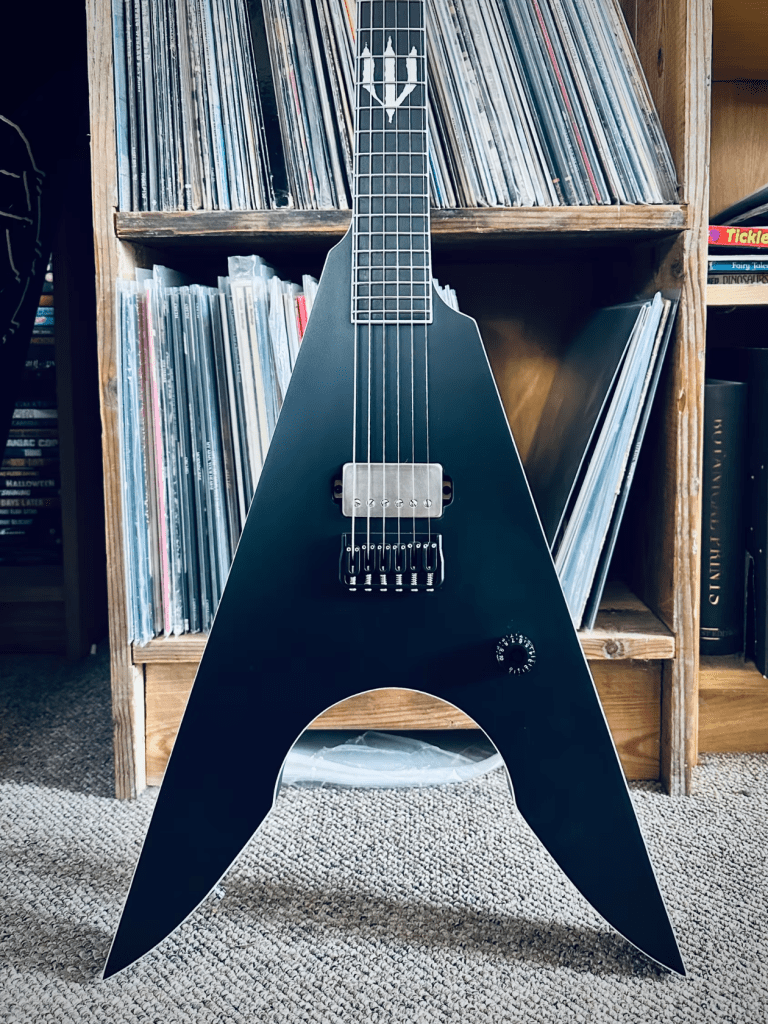
All of the guitars were recorded on my latest custom signature Violence VI, crafted by my friend Alex at Abhorrent Guitars.
In terms of amps etc, the album was quad tracked for both rhythm and lead, so it was a mix of different amps and even a subtle hint Boss HM2 if you listen closely.
In metal, the music being good is paramount. Luckily, Trivax brings great music first, but Trivax also has a fascinating story to tell. I’ve got to ask about the Iranian underground scene. Westerners (myself included) cannot imagine the level of danger and anxiety that comes with organising an underground or illegal performance in a country that is under a strict, repressive regime. Did/does Tehran have a big underground scene? How was it ever possible to promote a gig under such conditions? And, I guess I have to ask, what exactly is the punishment for being an attendee or performer at an illegal event over there?
It’s a fair question because the shows that we played were of course not legal. In our case, we never actually sold tickets for them and instead had these events where people could simply attend for free, but then we always sort of lied about the contents of the events.
For example, our very first show was the at the amphitheatre of a high school in Tehran where we had lied to them and said that we were going to go there to celebrate the anniversary of the Islamic Revolution. The show took place on February 2011 and we simply went to the high school and performed to about 200 boys filled with testosterone, most of whom hadn’t heard of metal ever before.
The show ended with them setting the place on fire and having to evacuate.
There were other instances of course where we played and lied again about the reasons and what we were actually going to do, luckily we never got arrested but friends of ours did. I was once at a show which was fairly limited capacity but as soon as the band started the first song the owners cut out the electricity for the room to avoid a police raid.
These were the kind of things that we had to deal with, although perhaps I’m under-exaggerating here.
Leading from that, once upon a time there was some Watain graffiti spray painted on a wall somewhere in Tehran. Just because I don’t want to trust ChatGPT or Google for an answer, I’ve what is the punishment for graffiti of that sort in Iran? And as someone who doesn’t know much about the story behind the image, was this graffiti sprayed onto anything in particular or was it just a random wall?
Good question! So you will definitely get done for defacing public property – Which is standard everywhere except that like most things, Iran has harsher laws. That aside, if the spiritual and cultural elements of the graffiti were revealed then we would have been fucked. Certainly imprisonment, maybe possibly even death.
The judiciary system in Iran is extremely corrupt, so sometimes your guess could be as good as mine, but either way the outcome wouldn’t have been healthy, let’s just say that.
Sticking with the theme of Iran, I wanted to know, in your opinion, who is the biggest metal band from Iran, and then, if anything has changed in regards to performing extreme music since the time you left for the UK?
Probably Arsames? I played with them as a guitarist quite a long time ago and they used to have a fairly large following, but I don’t know if they are really active nowadays since they left the country.
Nowadays, in terms of Metal, it’s probably between us and the band Confess, speaking of what people recognise as Metal bands from Iran.
Image credit: Necroshorns
Your art is often heavily influenced with the symbolism of Satan, so I’ve wanted to ask what does Satan mean to you personally? Having watched some of your YouTube videos, it is clear that you have a firm sense of humanity within you that I am sure would shock your average non-metal fan by the juxtaposition between the two. Now obviously, there are various forms of appreciation for Satan, from in the abstract as a vessel of defiance through to the very literal. So I wanted to know, where do you sit on the Satanic spectrum?
Let’s put it like this: I’m grateful for the opportunity to access and connect with the dark side of my being (the shadow self) through the left hand path, during my earlier years.
In terms of where I sit now, conceptually, I’m much more drawn towards the Promethean aspect, and the spirit of rebellion attached to it. But I relate to this more because it’s rebellion for the sake of “better things”.
The nihilism of modern day Satanism (theistic or atheistic) is not something I’m interested in at this point in my life, in fact, quite the opposite – I am for life, for humans, for nature, and I believe that we can do much better than this.
The anti-life/misanthropic approach seems truly asinine to me.
Following on from that, it probably isn’t a surprise to learn we love obscure, occult, and esoteric literature over here at MithraicHQ. With that in mind, is there any literature you would recommend? Either for your fans to discover more about the themes in your albums, or just in general. What does Trivax recommend?
Of course. There are so many, and it depends – but as far as books are concerned, I’d say anything by Carl Jung, Thus Spoke Zarathustra by Nietzsche, As A Man Thinketh by James Allen, these are good as far as personal blueprints to life are concerned.
I would also recommend reading more about Zoroastrianism, the ancient religion of Persia.
Outside of what is listed above, is there anything else Trivax recommends their fans should check out?
Listen to the Iblis Manifestations podcast.
I also always like to know some of the smaller bands that the artists I’m speaking to appreciate. Are there any bands you believe deserve a bit more appreciation for their contributions to the art?
Sure, Lavizan Jangal (IR), Ninkharsaag (UK), Andavald (Iceland) and Magnesium (Japan).
[Editor’s Note: Magnesium is a hell of a shout!]
The last thing I wanted to ask about was Persia. I feel like Iran being closed off from the world means many of the great and fascinating stories of Persian history are not getting the same attention as other important ancient civilizations like the Greeks or Romans (despite their importance to the development of the modern world!) As someone who grew up there, is there anyone you would recommend that talks about the fascinating history of the region before the 20th century?
There a lot of great sources to learn about the history of Persian empire. Too many, in fact. And even I [can’t] claim to know them all. But it’s fairly simple, like anything, you can just look it up online or search for documentaries on YouTube.
And finally, what does Trivax have planned for the remainder of this year and into 2026? Any events booked, any other plans?
Yes, quite a number of shows happening in that timeframe. We have a one-off headline appearance at the Deadsoul Fest in Ipswich, UK on 1st November, then we are doing a European run with Absu/Zemial as well as Ancient from 28th November to 14th December.
Alright Shayan, that’s me finished with my questions, but before we wrap up is there anything you’d like to add before we finish today?
Wishing everyone reading this a powerful triumph over all obstacles. Lift weights, visit nature, listen to good music, and don’t give into mass hysteria. Be bold.
I appreciate your time today, Shayan!
HTBLOF.
In a world where extreme metal often risks becoming formulaic, Trivax breathes life into the genre with music forged from struggle, defiance, and an unshakable will to create. Their journey from the underground of Iran to the stages of the UK is more than just a story of survival, it is a testament to the power of art as rebellion and transcendence. Standing tall within the extreme metal landscape, Trivax proves that true darkness shines brightest when born out of fire.
Not only do Trivax have a fascinating story to tell but they’ve also got the music to boot as well. If you’ve not already, make sure to check out The Great Satan, as it truly is an excellent album and definitely one of my favourites to come out of the UK this year.
As always, if you enjoy and can afford it, you should definitely go and buy it!
Links:
Trivax Bandcamp
Iblis Manifestations Podcast

 Mithraic Magazine
Leave a comment