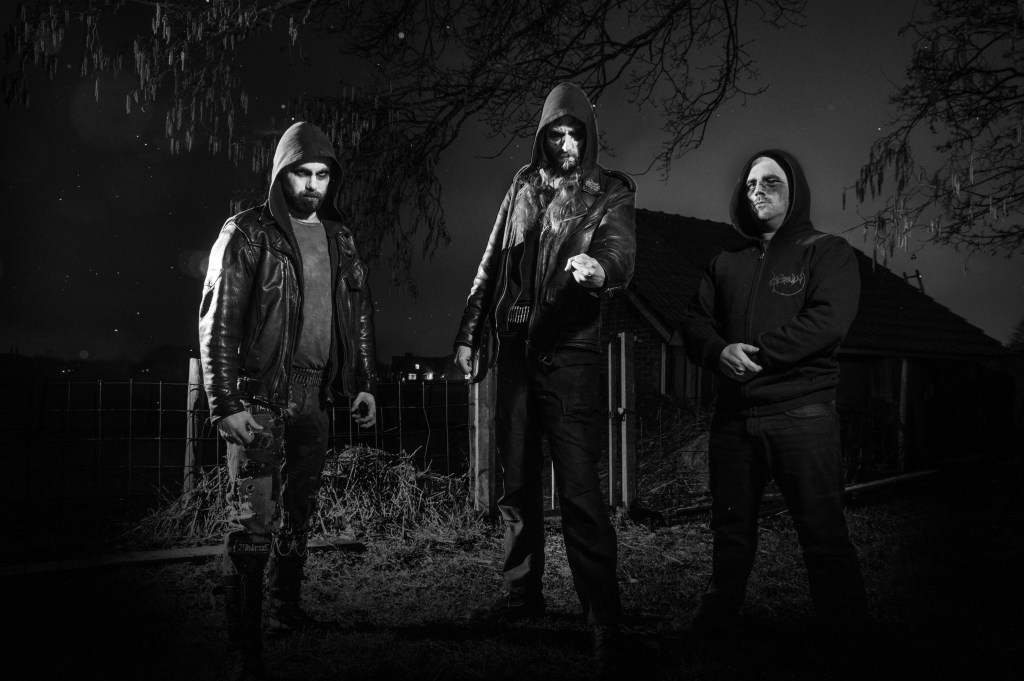
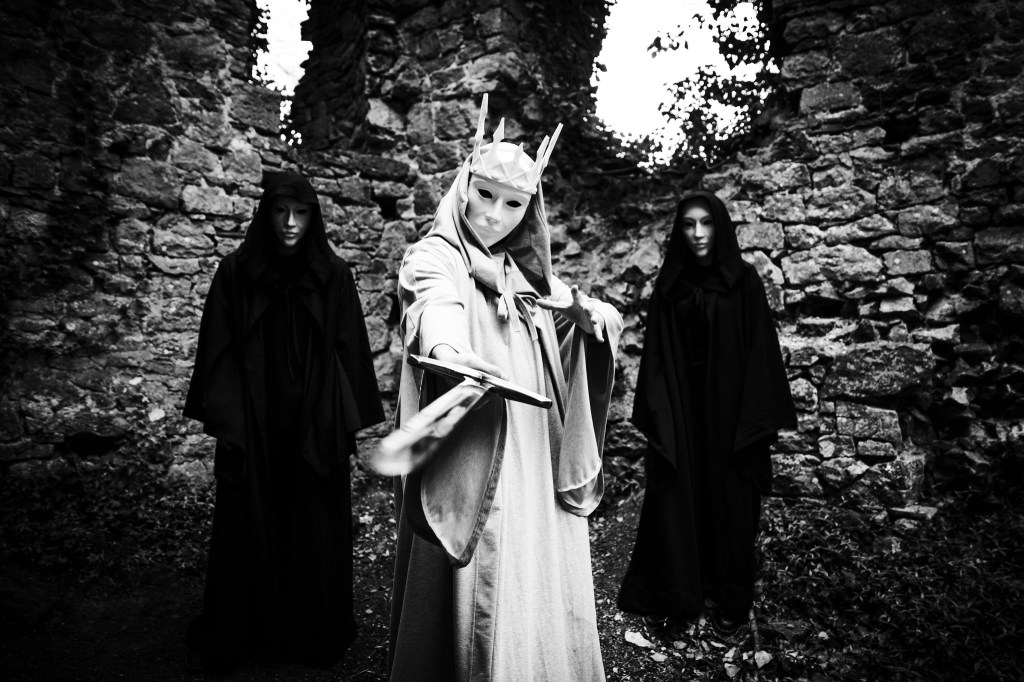
Rising from the frozen, semi-submerged landmass of the Netherlands, Asgrauw have become a formidable presence in the modern black metal landscape. Rooted in the raw spirit of the ’90s while embracing a distinctly Dutch sense of atmosphere and melancholy, the trio channel a sound that’s both feral and introspective. Their music merges icy riffs, venomous vocals, and a haunting melodic undercurrent that evokes mist-covered fields and ancient grief. Across their releases, Asgrauw have refined a style that feels timeless, and not through nostalgia but through a fierce devotion to the essence of black metal itself.
This year saw their latest offering Oorsprong, and bringing with it the harsh, cold sea air atmosphere that batters and bruises the Dutch landscape. At times poetic and melancholic, at other times a raging storm that thrashes around the listener’s cerebral cortex like blistering winter waves battering a coastal town.
To learn more about the project, I caught up with Kaos to ask about the latest release, their fiercely Dutch identity, and what’s still left to conquer for the band.
Appreciate your time today, Kaos!
Asgrauw Interview (With Kaos, by D.)
I always like to start by asking, in your own words, what is Asgrauw and how did this project all begin?
Asgrauw is a Dutch black metal band that pays homage to the second wave of the genre, while adding its own twist by infusing elements of aggression and raw energy drawn from punk influences. The name Asgrauw carries multiple meanings: its literal translation is “ashen grey,” a pale color, but it also refers to a moon phase and, in Dutch, can describe a gloomy or oppressive atmosphere.
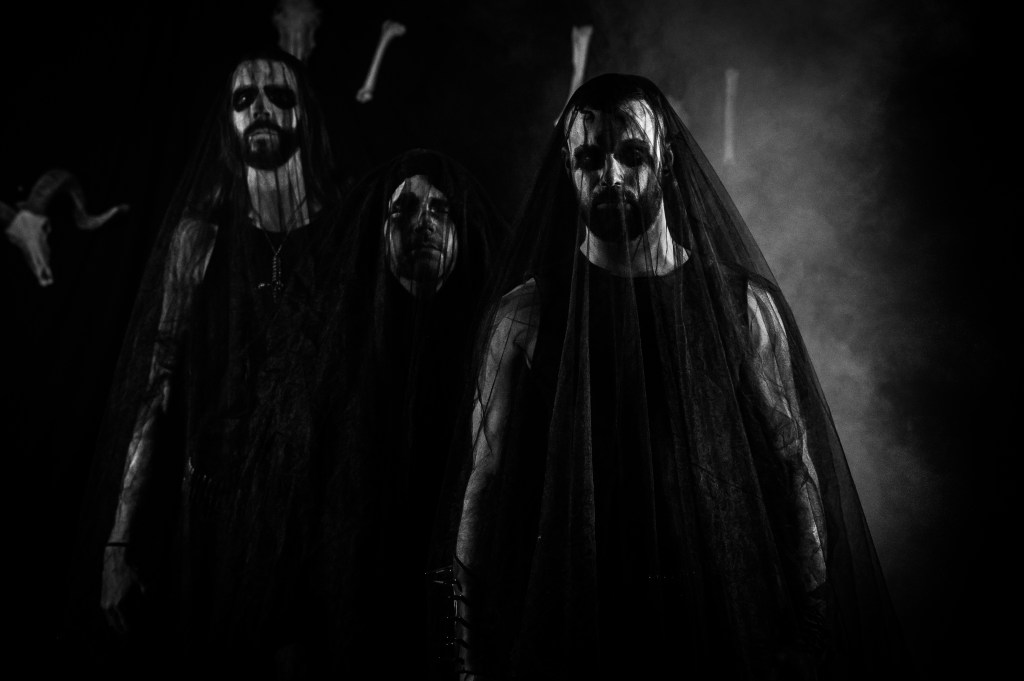
The band was formed at the Maddogs bar in our hometown (Groesbeek, the Netherlands) by Vaal, Takk, Haat, and me (Kaos). Now, more than fifteen years later, Asgrauw has long been a steadfast trio (Vaal, Kaos, and Batr) remaining as active and passionate as ever. Roughly every two years, we release a new album that continues our signature sound, and several times a year we perform live shows.
Let’s talk about Oorsprong, as it’s a solid release. I genuinely enjoyed that album. How has the reception been now that we are approaching its first anniversary? And were there any interesting opportunities unlocked off the back of this release?
Besides writing individual songs, we’ve increasingly focused on composing complete albums with a solid DIY production. Oorsprong is, from a production standpoint, the best work we’ve delivered so far. Musically, it’s also our most advanced album to date. With each release, we keep learning new things and grow tighter as a band. We’re very satisfied with the result, and the album has been well received. The vinyl edition sold out around the release date and was reissued earlier this year on colored vinyl. The CD and tape versions have also been selling quite well. We celebrated the album release together with our friends from Hellevaerder and Zwart during an awesome release show.
Listening to Oorsprong, I genuinely enjoy how it captures so many of the notes I want in black metal but still, at the same time, doesn’t sound like anyone else in particular. It’s excellent, at moments it goes from Suhnopfer-esque melodic ferocity down to the more atmospheric, and grand passages by the likes of Drudkh. Then there’s elements of more classic Norwegian and Finnish black metal, and basically, it sounds like a melting pot of all the best kinds of black metal. But because of that, I wanted to ask you, at least back in the beginning, which were the projects that influenced or inspired your sound? And have these influences changed over time?
From the very beginning, we’ve been mainly inspired by the second wave of Scandinavian black metal, and the sound of the classics from that era still echoes through our music today. Our drummer gravitates more toward the symphonic Norwegian style, while our guitarist is drawn to the chord-based, riff-driven Finnish approach to black metal. Our bassist prefers his black metal raw, heavy, and straight to the point. We don’t set any boundaries when it comes to drawing from these influences, it all blends perfectly together in one melting pot. We enjoy writing slow, heavy, and dragging parts reminiscent of Drudkh, with a strong sense of melancholy and melody, but we like to include sections driven by energetic punk rhythms or relentless blast beats just as much. One band we’re often compared to is Monarque.
Continuing with Oorspong, it sounds like it was produced in a professional studio but Metal Archives tells me it was a DIY/inhouse project? If so, hats off to Batr, because the mixing is really nice and clear while never losing any of that aggressive edge or intensity. So let’s talk about it, how and where was this project recorded, and later mastered? How was the experience overall? Were there any challenges you faced while recording this album, or was it mostly smooth sailing?
With the exception of our debut album, we’ve always recorded and mixed everything ourselves at home, although mastering had been outsourced up until this latest release. For Oorsprong, we asked our friend Devi Hisgen to handle the mastering. One distinctive aspect of this album is the frequent use of sound samples between the tracks, created by Dify.
The big advantage of the DIY approach is that there’s no time pressure whatsoever. We record our music without stress, evaluate the takes, and redo whatever needs improvement. In the early days, our process was more primitive, and we were satisfied with a more “necro” sound. These days, we set the bar much higher, at least by DIY standards, and aim to get the absolute best out of our setup. What we consistently guard against, though, is letting it sound too smooth or plastic. Even though we use modern digital tools, there has to remain a sense of organic rawness in the production.
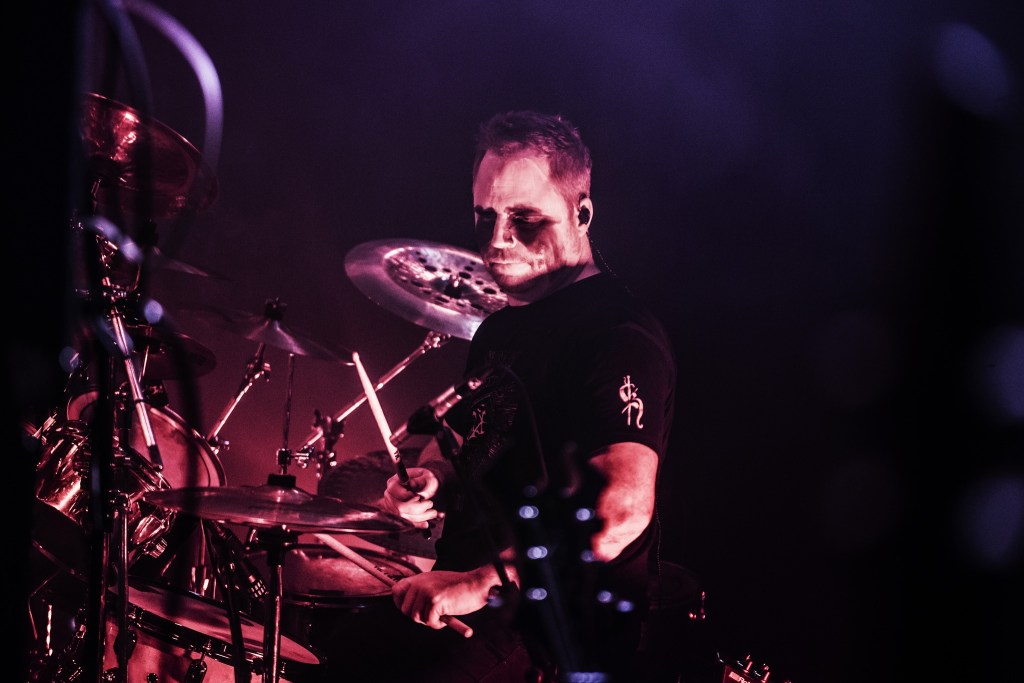
Our drummer, Batr, takes care of the recording and mixing. He records the drums at home in his attic using a hybrid drum kit. Guitars, bass, and vocals are recorded in our rehearsal space – which is basically a stinking old chicken shed. That setting actually adds to the atmosphere, in contrast to a clean and sterile studio environment. Of course, things sometimes go wrong: malfunctioning laptops, and on this album, even a major crash that caused us to lose some recordings! Mixing the two vocalists, Vaal and me, each with a totally different frequency range, is always a challenge as well.
What does the composition process look like for you guys? Is there a main songwriter or is it more of a group collaboration? And what equipment do you guys use (or recommend) for your recordings?
The music is primarily written by our guitarist, Vaal. He comes up with the riffs, and we work on them together in the rehearsal space until we have a usable blueprint for a song, including drum patterns and bass lines. After playing a song collectively for a few weeks and it feels right, we start the recording process, which we also approach song by song. During recording, the songs are often further refined. Sometimes even the arrangements are adjusted if things don’t feel right, and vocal lines are added along with keyboards. I take the lead on the lyrics. We record using Cubase software through a Solid State Logic SSL12 4-track interface.
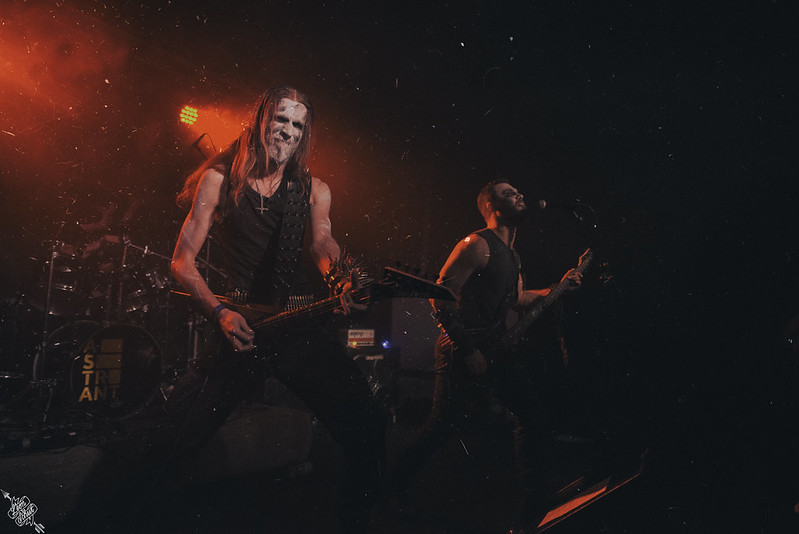
Something I like is when artists keep their native languages in their music, which is something that has been a constant with Asgrauw from the start. I like it because when you are trying to learn a language, generally, the lyrics found in black metal albums provide more interesting topics to translate and learn about than your typical beginner’s class. But anyway, I wanted to ask, how much does the Netherlands influence your sound, and in what ways? Was there any larger motivation for keeping your music in Dutch?
Naturally, one expresses oneself best in their native tongue, and lyrics are important to us. The advantage of Dutch is that it sounds harsh and gritty, with the typical “grh”-sound unique to our language. We even released an album, Gronspech, that uses a local dialect. We also believe that, for non-Dutch listeners, this may add to the mystique of the music, much like how we enjoy albums from Scandinavia or other countries without understanding a word.
As for whether the Netherlands itself influences our sound, that’s a good question. We mainly draw inspiration from foreign acts, but we often hear that the Netherlands has a distinct black metal wave, and that Asgrauw is part of it. If that’s truly the case, then this sound has slipped in unconsciously.
Admittedly, the benefits of using lyrics to help learn a language almost doesn’t apply here as finding a copy of your lyrics online is a problem even in Dutch! But, of the lyrics I could find, it is heavily influenced by Ancient Sumeria. As fans of the history of the region ourselves, what inspired you specifically about this time and culture to use it as the premise for Apada? (And presumably Eridu too.)
We published all the lyrics from this album on our socials in Dutch. Normally, we don’t release the lyrics alongside the album, but for this one it made sense. If there is ever a CD repress, we will include a booklet with the lyrics.
What inspired me to write a full album about the Annunaki — from their origins on their planet to the possible future of this world — is the comparison you can make between the old clay tablets and “holy” books like the Bible. And since the clay tablets are much older…
Outside of the historic, we also like the esoteric, the arcane, and the occult, over here at Mithraic Magazine. With those keywords in mind, is there anything you would recommend? Either for your fans to learn more about the concepts behind your music, or just in general for our readers?
For Façade we may dived into more occult stuff. Interesting things to look up are: Bokor, Haïtian Voodoo priest who steal souls to make zombies out of the living or bring back dead bodies to life. The Aghori, Hindu monks that devote their lives to Shiva, who live in cemeteries, cover themselves in cremation ash and practice cannibalism. Or disorders like Cotard’s syndrome, which is also known as walking corpse syndrome or Cotard’s delusion. It is a rare condition where individuals have the delusion that they are deceased, are putrefying, or have no body parts or internal organs. And Locked-in syndrome (LIS), a rare neurological disorder where a person is fully conscious and aware but cannot move or speak due to damage to the brainstem. Individuals with LIS can typically communicate by using vertical eye movements or blinking to signal thoughts and feelings.
Then, excluding anything mentioned already. Is there anything in general you or Asgrauw recommends?
Going back to Oorsprong: I read books by Erich von Däniken, especially Chariots of the Gods, and The Book That Will Forever Change Our Ideas About the Bible by Mauro Biglino.
I always like to ask, are there any smaller, or more obscure bands you think deserve more recognition for their contribution to the craft? And are there any Dutch bands you believe we should also be listening to?
Of course, all the bands and projects from the Zwotte Kring collective. In addition, Veenlijk is a great young black metal band, and we should also mention old-timers from our scene like Sammath and Kaeck. Let’s not forget the bands from our Flemish neighbors either, such as Nether and Nyrak. And of course, all the bands that are released through Void Wanderer Productions.
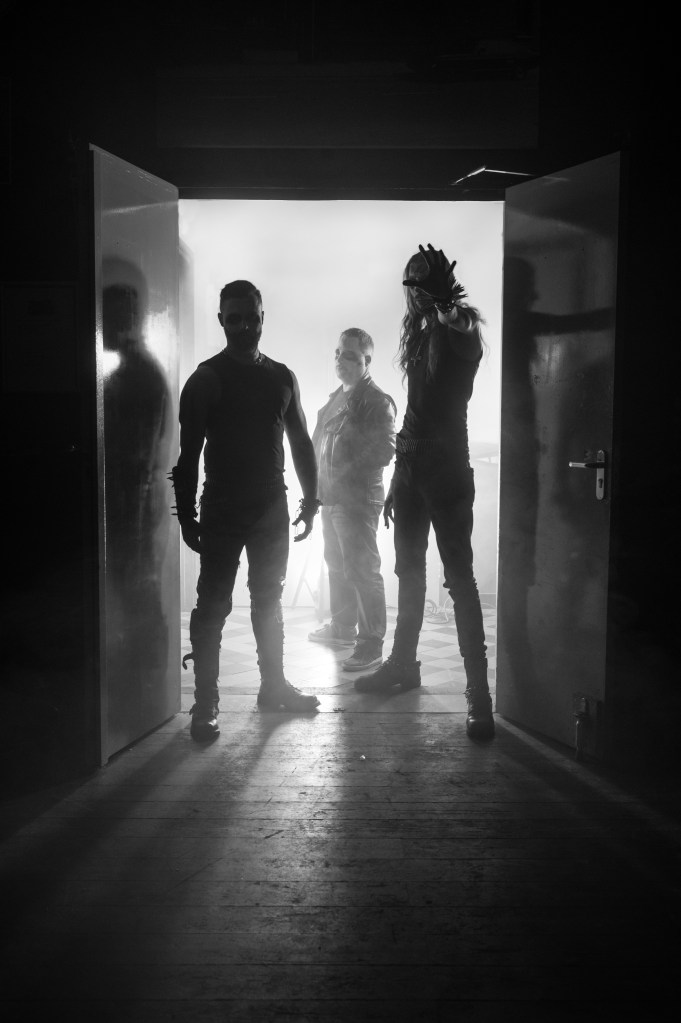
Then let’s talk about Void Wanderer Productions, because it’s quite an impressive operation you’ve set yourself up there. What was the motivation for setting up a label and distro? Is there anything in particular you’re looking for when deciding what to pick to release through VWP?
Back in 2012 and 2014, when Asgrauw finished our promo and debut album, I didn’t really know how the whole business worked. I emailed two or three labels, but we didn’t get the responses we were hoping for, so I decided to release it myself (without a label name). For the debut CD, Schijngestalten, I pressed 500 copies, and at that point, I started trading with labels. I quickly got a distro box to sell at shows. However, I also discovered that most labels weren’t really interested in trading with a band, since they could only stock one or two albums instead of a box with 10+ different titles for their distro.
These days, I receive multiple submissions every week, sometimes more than twenty. To give each release the attention it deserves, I only do one release per month. I also have a list of things I don’t do. One of them is that I normally don’t re-release an album that was already released by another label or is available on the internet. The reason is simple: I like to focus on promoting an album, and if it’s already out there, it limits many of the PR opportunities.
Now that 2025 is closing fast, what have you guys got left in store for this year, and what’s in the plans for 2026?
At the moment, we are in the mixing phase for a new Asgrauw album. This time, we are also doing the mastering ourselves. After that, I’ll compare offers and decide through which label we want to release the album, hopefully it will be available by the end of 2026.
We also have four shows planned for 2026, including a very special one. We will be performing the Verloren Vertellingen split album live, featuring Asgrauw, Schavot, Hellevaerder, and Duindwaler.
And before I let you go, I’ve got to ask, is there also anything in the works with Meslamtaea? Underrated project featuring Floris and yourself. 2024’s Nihil Vincit Omnia was a funky EP, can we expect to hear more?
Meslamtaea was originally a one-man project by Floris (Batr), founded in the late ’90s, and around 2017 it gained renewed energy when I joined as a permanent member. After that, two more members were added. The music is much more experimental and draws inspiration from bands like Fleurety and Ved Buens Ende. Since Nihil Vincit Omnia, Floris has already recorded four new songs, but the process is moving slower than hoped, even though we’re eager to keep going. We might release it as an EP or a split, or perhaps turn it into a full-length after all.
Finally, is there anything you’d like to add or say before we finish today?
Thanks for having me and let me explain some things around Asgrauw. On the 18th of December my label Void Wanderer Productions will release the debut of Batr’s next side project. Batr made a blackened doom EP together with Zwotte Kring brother Daan (Duindwaler/Hellevaerder).
Appreciate it, Kaos!
HTBLOF.
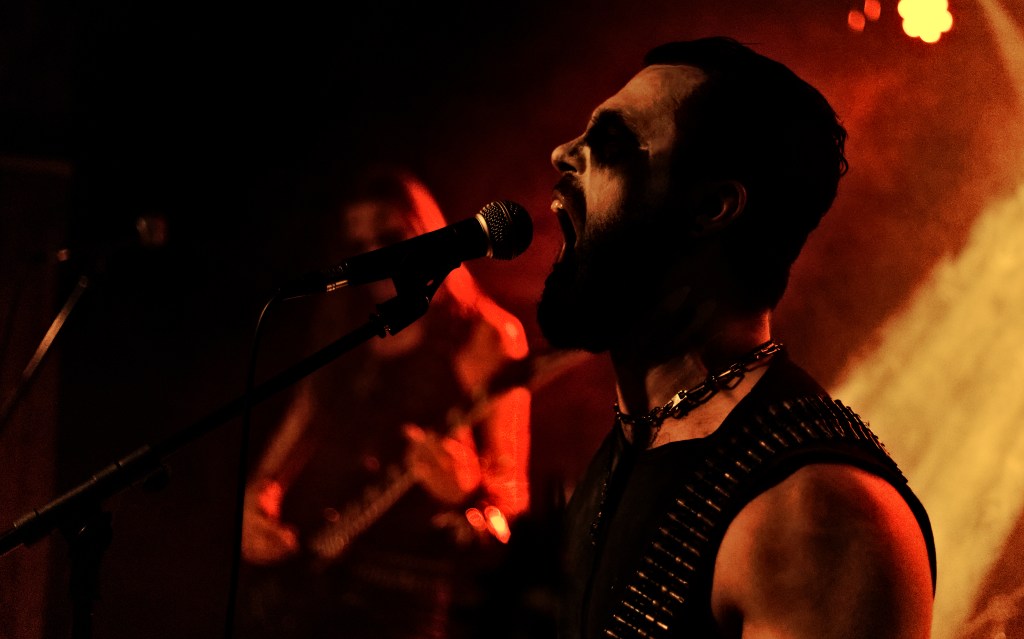
And there we go, direct from the source.
Asgrauw stands as a testament to the enduring power of black metal’s spirit; unbending, atmospheric, and deeply human beneath the frozen veneer. Their sound captures both the vastness of the void and the cold of the land that birthed them, balancing their sound nicely between tradition and personal vision leading to a familiar but new experience with each release. In an era where trends shift and fade, Asgrauw’s music will return like the cold winter wind over the Dutch landmass itself: relentless, earnest, and enduring.
If you’ve not already, I highly recommend you could out 2024’s Oorsprong. A genuine treat, and a testament to the current strength of the Dutch black metal scene overall.
Remember, if you like it and can afford it, you should definitely buy it!

 Mithraic Magazine
Leave a comment