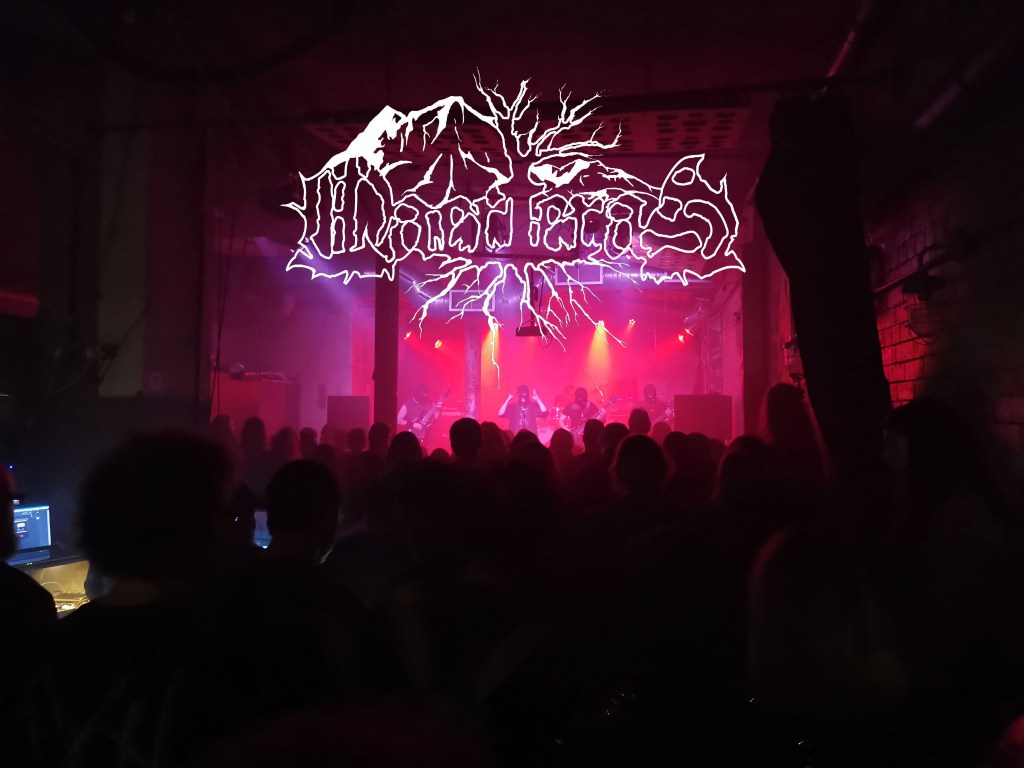
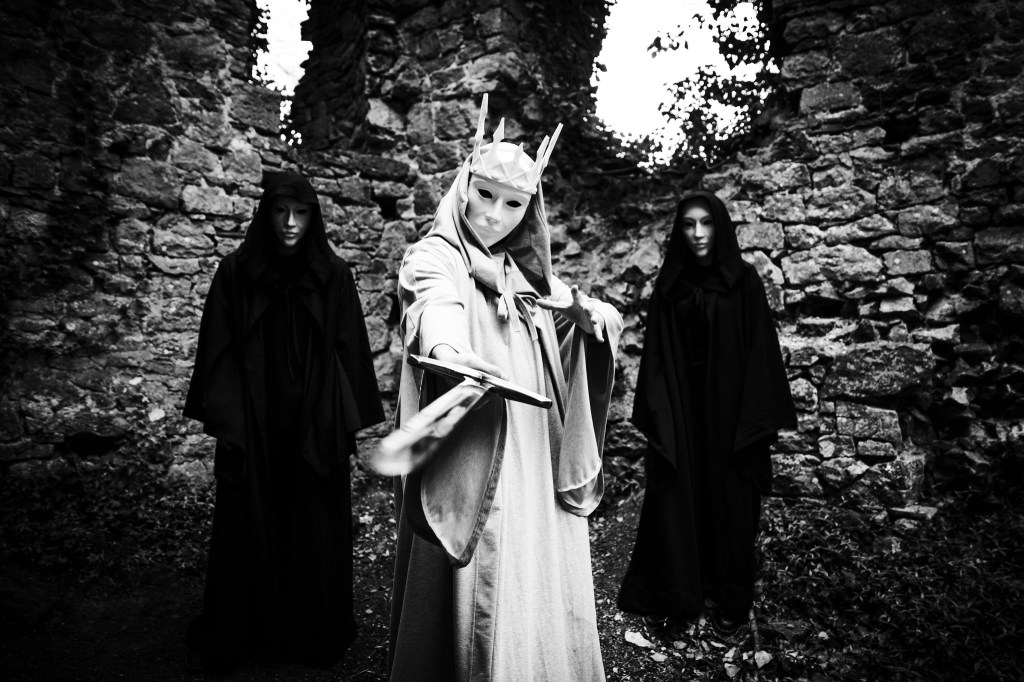
Back in late 2024, D.K., the vocalist, lyricist, co-songwriter, and conceptual artist behind the Pictish-Mithraic black metal outfit Waerteras, sat down with Astronomiica to give the band’s first-and-only ever interview where they discuss the band’s foundations, meaning, and potential future.
D.K: Vocalist, lyricist and co-songwriter of Waerteras (Interviewed by Astronomiica, Nov 2024)
First of all want to say a big hello there D, and extend my most gracious thanks for accepting to be interviewed considering neither of us currently know where it will be released in a few weeks! Ha ha.
Ave, thanks for reaching out.
Have you had a brutal (in a good way) Scottish summer? What has been going on for Waerteras and all you crazy cats?
You know, it’s been quiet on the Waerteras front recently. Like how Britain entered its Dark Ages after the Romans left, Waerteras entered its own Dark Ages during the recent plague. Though, seeing as the world looks pretty Medieval right now it might be an appropriate time to reignite an old flame.
Recently, I have been organising a few festivals, A has been relocating after being banished from his homeland, D is flying in the skies above us, while M and C have been busy helping sinners.
I guess before we get into the questions, we should maybe elaborate more on the chosen band name. Could you explain a bit and/or in supreme details where the name comes from and a bit of the story behind its meaning for you and the other members?
The word ‘Wærteras‘ is the old Northumbrian word for the Pictish people of Ancient Scotland, used by the Northumbrians to describe us during the 6th to 10th centuries.
However, it wasn’t just them calling us Wærteras. Earlier, starting around the 4th century, the name in Latin was Verteris. If you remember that in Latin the letter ‘V’ was pronounced like a modern ‘W’, you can hear the similarities between the names Wærteras and Verteris, meaning they were likely attempts to replicate what the Pictish people called themselves. Both Wærteras and Verteris also have similar meanings in their respective languages and mean something roughly equal to hill or fortress people, which fits as Pictish hill forts are a common feature of the landscape here.
What was most important to me was that I wanted a name that represented my people and our history which was used historically and wasn’t some assumption or best guess like the proposed “Pictish spelling” of ‘Uerteru’.
You guys started this project just around the time of the beginning of the first apocalypse of our age (covid), or at least released your first demo and full length then (both titled demo MMXIX and Under theGuide of Capricornus, respectively). What were some thought processes going on through your mind then? Some struggles? How did you keep the fire alight?
The project really took off in 2019, though we first released a song under the Waerteras banner just before A. left Scotland, it was called Mons Graupius 83AD, and was about the ancient Caledonii, Vagomagi, Taexali, and other tribes of the Highlands battling against the Roman IX legion near the Pictish fort atop Bennachie.
Though, as back in 2016, then later in 2019, and still today, the fire is kept alive by a genuine desire to talk endlessly about the mysteries of the Picts. Of course, there is also a more personal side to it all, but people will need to read between the lines to decipher that. I can say the main inspiration for this project was the perception of the parallels between then and now. History inevitably repeats given enough time as only technology changes, people do not.
The realisation of that parallel between the end of the Pictish period and today is what spurred the creation of Under The Guide Of Capricornus. There was and is chaos and upheaval globally, there is the desecration of temples once held sacred, and there are deceivers working on behalf of the greedy and the cruel to manipulate and master the inept and the ignorant.
A Devouring Death; Necrotic Rot of the Mind, Body, and Soul was written to discuss this and tells the story of the fall of Pictavia, who witnessed the arrival of Christian mystics with strange ideas and new beliefs that seemed innocent and benevolent but would ultimately go on to systematically eradicate all that existed before it.
Following a bit, you mentioned when we last spoke you guys are spread all over the place. I see Cyprus mainly and here in bonny Scotland. How did you and the other members meet? You played with another member if Im not mistaken in your project Twisted Broken Bone, (reference to Broken Bones? Haha couldn’t find any sounds online!) What made you guys shift directions?
At one point or another, we had all played in at least one other project with another member of Waerteras. Myself and A met in Forres in the early 2010’s and have been making music since, with projects like Inverted Cross in 2012, Warmachine in 2013, and Forresian in 2015, to name a few. A relocated to Cyprus around 2015 and met D, M, and C, who I would meet in 2018.
As for Twisted Broken Bone in 2019, that was a Peep Show inspired death metal side quest that myself and A recorded and released quickly in between writing Waerteras’s Demo and the UTGOC album in 2019. It is our deeply held belief that Peep Show is the greatest TV show ever written. Hail Peep Show.
But to answer the question, part of what made Waerteras’ sound was the fact A doesn’t care much for genres or sticking within their limitations. Quite often A will shift direction simply because he can. Like a musical parrot, he can hear and then imitate any genre he listens to and as a result ends up taking inspiration from the most random of places. Twisted Broken Bone was essentially a bunch of riffs that could never be used on a Waerteras track finally finding a home.
Waerteras lyrical content got me even before I had the gripping thrill of listening to your guys’s music. From my reading, the words encompass tales, personal struggles and incorporate subtle mixing of ancient belief systems from ancient Persia all the way to Hinduist interpretations. Could you elaborate a bit on your main source of content and where it reaches you the most? And perhaps how have you grown/shifted through putting out this sort of –what seems- very deep and personal content.
For the esoteric inspirations, the source is simple – it’s all One; something we have known since the beginning of time but have been convinced into forgetting in recent millennia.
An Expanding Sphere of Infinite Desolation was written around this subject, that we are the Creation of the Cosmic Womb. We exist inside the belly of a Mother Goddess, the Universe itself. According to our creation myth, The Father God, “the Pictish Beast”, impregnates the Cosmic Ocean in the dimensional plane above, resulting in pockets of Creation being born, which grow and expand through the void beyond.
From our perspective, our Universe may seem infinite and immortal because that’s all we can see, but She is mortal and She deals with forces beyond our comprehension in a plane of existence we can barely conceptualise. Eventually, our mortal Universe will die as a result of those forces we will never know or understand.
However, Her death will fertilise the Cosmic Ocean and the cycle of life and death will restart itself as it has done before and will do again. The Great Cycle is cyclical and it is eternal, this is a core belief of Pictish Mithraism.
In relation to Waerteras, the Bull is the common theme: The Bull is the animal of the former Pictish capital at Burghead, and it is the animal slayed by Mithras as depicted in the tauroctony at Hadrian’s Wall. It is the same Bull as the Bull of Heaven in the Epic of Gilgamesh, and it is also the same Bull that became the Minoan Minotaur in Crete. It is not a bull; it is the Bull.
Addressed in the album is the fact the same deities exist under different names to different cultures, such as Ea, Enki, Pan, and Coventina, who are all likely representations of the same God. The Bull is no different, with both Coventina and the Bull also having direct links to Mithras as evidenced by archaeological finds from within Britain itself.
Although they wouldn’t be esoteric mysteries if I revealed them to everyone and said exactly what I believe them to mean. That said, what I’m preaching is not new. It is knowledge we have had for at least the last 4’000 years, of which we can evidence around 3’000 years of that with fragments of written works that have survived until this day.
Outside of sharing a place in the night sky and a specific moment in time, these Bulls also remind us of the cyclical nature of existence. Eventually, the human defaults for death and devastation will reign supreme with all the meaning, majesty, and mystery of what came before us lost, leaving us only the ashes to sift through when looking for truth. In the end, the same fate will befall our time and civilisation as well. What we know today will be lost tomorrow, just like the ancient tribes that came before us. Whether it be a nuclear holocaust, comet, exploding sun, or two Universes colliding, we all know how this story ends. Entropy is the Universal default and the only thing that can be relied upon with time.
Unfortunately, we are a species with amnesia that have long been conned by charlatans and magicians into no longer believing, or even seeing, what is true. That is, history repeats. It always repeats, as does everything else. It is endless and it is cyclical. As above, so below. As below, so above – in the end, it’s all One.
What would you guys say are some of the musical inspos from your work? Also what do you spin music wise on a day to day basis?
We’re all musical nomads with wildly varying tastes. I mostly listen to black or death metal, but good music is good music. For Under The Guide Of Capricornus, the inspiration musically was a combination of Furia, Drudkh, and Mgla.
I enjoy the melodic, aggressive, blastbeat kind of metal, so bands like Dissection, Sacramentum, Suhnophfer, Arckanum, Plaga, Sombres Forets, Forteresse, Monarque, Cardinal Sin, Demonical, Dismember, At The Gates, Power From Hell, in addition to Furia, Drudkh, and Mgla, get a lot of plays from me.
Though right now I’m listening to Coven, and earlier I was listening to Preston Reed, Charles Mingus, and Death. I’ve got playlists for everything.
Story time! Okay I could have done my research, but the last song on the Full-length album Under the Guide of Capricornus – The Black King, tells the story of a kingdom of Picts that are left without their king, as the invasion of the celts arrive (I think). Its beautifully written and we need to know more please. Ha ha, what is this legend? And which bridge are we talking about here?
Actually, the Black King was a King of Alba, the precursor of modern Scotland, who was killed by the Waerteras in Moray, then known as Fortriu. At that time, the former Pictish people did not willingly capitulate or peacefully join the Kingdom of Alba. As always, independence is taken away by force and through conquest. Yet, King Dubh wasn’t the only King killed in a final act of opposition from Fortriu. The song is about rebellion and in celebration of the three invader kings who were murdered by the Waerteras in Fortriu during their final stand before being subdued and incorporated into the Kingdom of Alba.
To explain, just after Pictavia fell the former lands mostly became part of the Kingdom of Alba, except for Fortriu. Fortriu would become the bane of Alba and refused to give in for another century or so.
Kenneth MacAlpin, King of Dal Riata, and the first ruler of both Picts and Scots, with the Scots being those who came from Ireland to form Dal Riata in Western Scotland, was given the title King of the Picts when he ascended to the throne, but not that of King of Fortriu.
Kenneth would die relatively peacefully to a tumour, and his son would die fighting Vikings. However, his son, then his son, and then his son, would all die to the men of Moray. The historic Kingdom of Pictavia through Fortriu essentially started a spree of regicide as a final act of defiance, slaying Donald II, Malcolm I, and Dubh, the Black King, all in the vicinity of Forres. They even got the Scandinavian King of Dublin, Ivar II, in between erasing Donald and Malcolm, though sadly not in Forres which does slightly ruin their spree of Forresian regicides.
There is a large, 6m tall Pictish standing stone that has stood for over 1’000 years standing in Forres today. However, which battle and coronation it is depicting is up for debate, although it has nothing to do with Sweyn Forkbeard from which its modern name is mistakenly derived.
But to address Dubh, The Black King, he was killed in battle against the Waerteras of Fortriu and was buried under a bridge near Kinloss. As a result, the legends say there was an eclipse from which the sun did not reappear for 1’000 days until the King’s body was found. We know there was an eclipse in 967, though whether or not it lasted for three years is up to your level of suggestibility.
The bridge itself has long since been destroyed, most likely just like the second standing stone which should be standing next to Sueno’s Stone in Forres providing us the missing context. Looking through old maps you can get an idea of where the bridge was. That said, the real holy grail would be rediscovering the second, missing Sueno’s Stone carving as Sueno’s Stone was the inspiration for the track. For the song I picked Dubh, The Black King, because that’s what the legends say. But, as Sueno’s Stone depicts a battle and a coronation at a point when there were many of those in that area, it’s hard to say for certain who it is depicted on the monument itself.
In the century-or-so around when Sueno’s Stone was carved and erected near Forres, in that area alone we have the deaths of Kings Uuen of Fortriu and Aed of Dal Riata to Vikings in 839, Kenneth MacAlpin’s coronation and the rise of Alba in 848, the murders of Donald II in 900, Ivar II in 904, Malcolm I in 954, and Dubh in 967. Meaning, there’s no shortage of candidates.
However make no mistake, this was no small moment in Scottish history. These two stones are the largest Pictish standing stones ever carved by the Picts, and they stood for 800 years before one disappeared off maps. Finding that second stone could reveal a lot about one of the defining moments of early Scottish history, and seeing as they stand over 6 metres tall and weigh over 6 tonnes, it didn’t just disappear overnight and would have taken some effort to move. So, if it’s not fallen over in a field, it’s likely stuck under a Christian church waiting to be rediscovered.
Symbols left behind from the Picts are very few, well any trace of them left is quite scarce in itself. On the album itself you guys have chosen one such symbol. Could you explain why and what it means to you guys? Also can you draw it for us here (you can do it! Ha ha).
Haha, I think I’m going to pass on trying to draw that one myself… But there are a few reasons why I picked it.
First, it is a unique symbol found on only one 8th century funerary slab in Scotland, which itself was only found after the Meigle church was destroyed by fire in 1869. Again highlighting how much of the Pictish past is hidden under a Christian carpet.
Second, it is a striking symbol that grabs your attention and represents the cycle of life and death, a universal symbol found on every continent with humans present and was first used over 12’000 years ago. The symbol itself can be seen as akin to the triskele found from Ireland to Malta between 5’000 and 7’000 years ago.
Third, that symbol died down in Britain and Ireland with the arrival of Christianity as there was no longer a cycle of life and death, instead, there was a guaranteed heaven and an afterlife which disrupted our knowledge of the Great Cycle and the Universal truth that ended its usage as a symbol.
So, to see it carved hundreds of years into Christianity’s arrival in Scotland and without any associated Christian symbols, such as the cross, suggests to me that it was carved as an act of defiance and rebellion; a rejection of their relative modernity and those who had come to impose their will upon them. Similarly, this is why we chose that symbol to represent this album. Both The Double Disc and the Crescent and An Expanding Sphere of Infinite Desolation speak on this idea that our deaths go on to fertilise the cosmos and reject the Christian notion of the afterlife being guaranteed. This is Astral Samsara, a belief that existed here long before the arrival of Christianity as evidenced by the symbol on the album cover and others that have been found like it.
This symbol is not just a symbol of Waerteras. It represents a core belief that we likely all once held before the arrival of the Abrahamic monotheistic curses that changed the common narrative and limited our thinking.
Do you feel Waerteras is in a way keeping a written history of a culture that is so very precarious in terms of well, everything (even how we call them picts is a roman term, we don’t even know how they self identified! ) Would your ancestors be proud?
I wouldn’t say it’s keeping a history of the culture as much as it is retelling the stories, myths, and legends of the Pictish past. The history of the people who we call Waerteras is only just beginning to be rediscovered. It was only a decade ago when some simplistic scholars would argue Pictavia didn’t have trade links with the outside world, so we should never assume anything that has previously been written about the Picts, or about the Waerteras of Fortriu, to still be accurate when looked at again.
And I don’t worry about their pride, but I imagine if anyone feels anything it would be Briochan, the 6th century Pictish mage who tried to stop Christianity from arriving in Scotland by controlling the weather and pushing their ships away from our shores. I reckon he would at least be pleased that we didn’t become Christians.
Alright, while this interview is drawing to its end I guess I have a feeew more questions before letting you off the hook to live life away from the screen.
Winter is on her way! Any upcoming plans where the band is concerned? Places youd like to play or fests youd like to attend?
We kind of discovered during the release in 2019 that A is a bit more Darkthrone than the rest of us. What I mean by that is he’s not really into touring. That doesn’t mean we won’t play live again, but it does mean it needs to be something special to tempt A back into a balaclava. That said, we’re always open to offers, so it can always happen.
What are you guys working on for the next upcoming year, if I may be so bold to ask?
We have plenty of demo tracks to turn into albums, maybe something like 25 songs at this point, but we’re also more careful these days as we do not want to cheapen the legacy of Waerteras by releasing something that was substandard or forced.
At present Under The Guide Of Capricornus stands as a bastion of Pictish pride, an album and project that we are proud of. It captured the best of A’s songwriting and was the perfect canvas for the Pictish mysteries I wanted to tell lyrically. It was then masterfully brought to life by the expert musicianship of D, M, and C, with all three being the most competent, capable, and complete musicians I’ve ever had the good fortune to work with. They were the reason myself and A were able to take this project out of the basement and gave Waerteras the strong backbone it required to successfully function as a live unit.
Alright D that draws the end for me here, anything else you want to add nows you’re chance ☺
Oh, I think I’ve probably said more than enough already…
Want to extend my humblest thanks for taking the time to answer all these and very much looking forward to hearing more from to rocking kittens.
All the best ,
Slainte Mhath!
Thanks again for reaching out, keep the dark arts alive.
Lloniannau a mwynhau.
Waerteras Links
Astronomiica Links


 Mithraic Magazine
Leave a reply to Exploring the Mysteries of Mithras Crowned: Black Metal from South Africa – Mithraic Magazine Cancel reply