
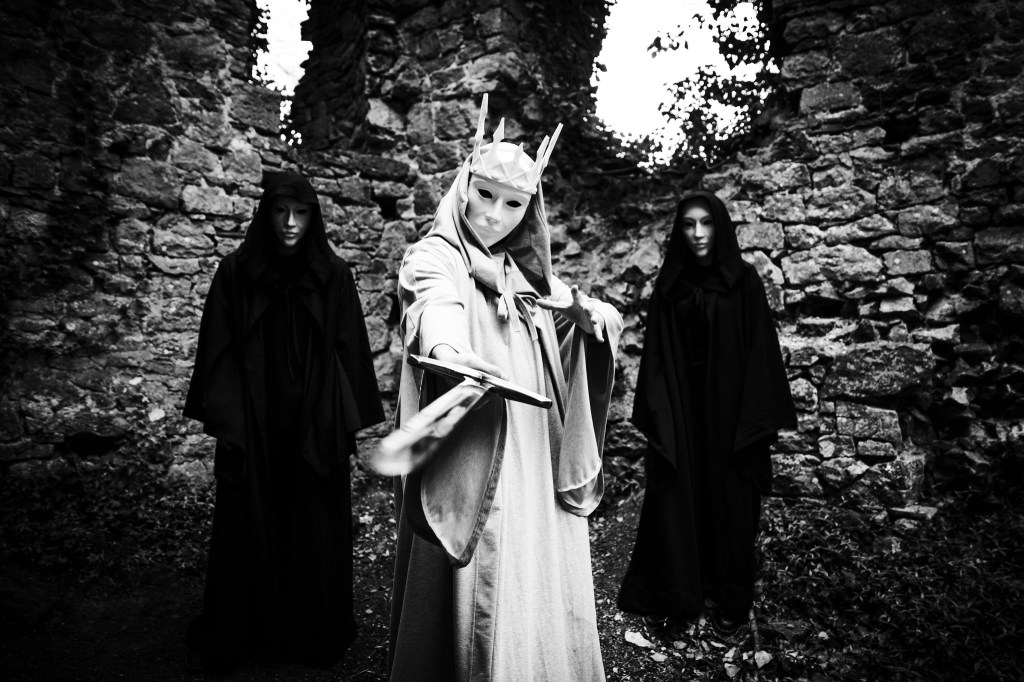
Necrowretch are a band that have carved its name deep into the tombstone of European death metal. Since their unholy inception in 2008, Necrowretch has remained unwavering in their devotion to the dark arts. Blending a feral mix of black and death metal that comes with relentless speed and a venomous anti-religious spirit. Yet, with each release, Necrowretch drags listeners deeper into a realm of chaos, where riffs slash like scythes and vocals rise like infernal incantations.
If you have not heard Necrowretch’s excellent 2024 release, Swords of Dajjal (released via Season of Mist Underground Activists), you really need to click on the Spotify or YouTube links throughout this article and fix that immediately.
Necrowretch have been building an impressive library of Satanic, demonic, and frankly fucking excellent, music for the last 17 years that has only continued to get darker with time. Necrowretch are one of the few exceptions who seem to only continually get better with age, as Swords of Dajjal, in my opinion, is their most exciting release yet.
Necrowretch have never been afraid to evolve, but never in such a dramatic evolutionary fashion that you’ve just watched a fish turn into a donkey, it’s always subtle amendments and kept within the character of what Necrowretch’s music is. These subtle changes over the years have only made the project go from strength to strength, release after release, and is why after over 15 years since the beginning of this quest they are still a powerhouse of French extreme metal.
Of course, I’m a sucker for basically anything black or death metal, which means you can give me any Necrowretch release and I’ll be all over it like a jakey is to spilt wine, however I do think Swords of Dajjal shows an evolution unlike we have seen from the group before. It’s refined – but only in the best kinds of ways, as clearly a lot of time had been spent honing these latest anthems to be as cutting as possible – which they have certainly succeeded in doing!
This is an interview that Zero and I had on our list of bands we’ve been meaning to contact. So we’re genuinely thrilled to be asking Vlad from Necrowretch some questions today about the project’s latest release and its deeper meanings.
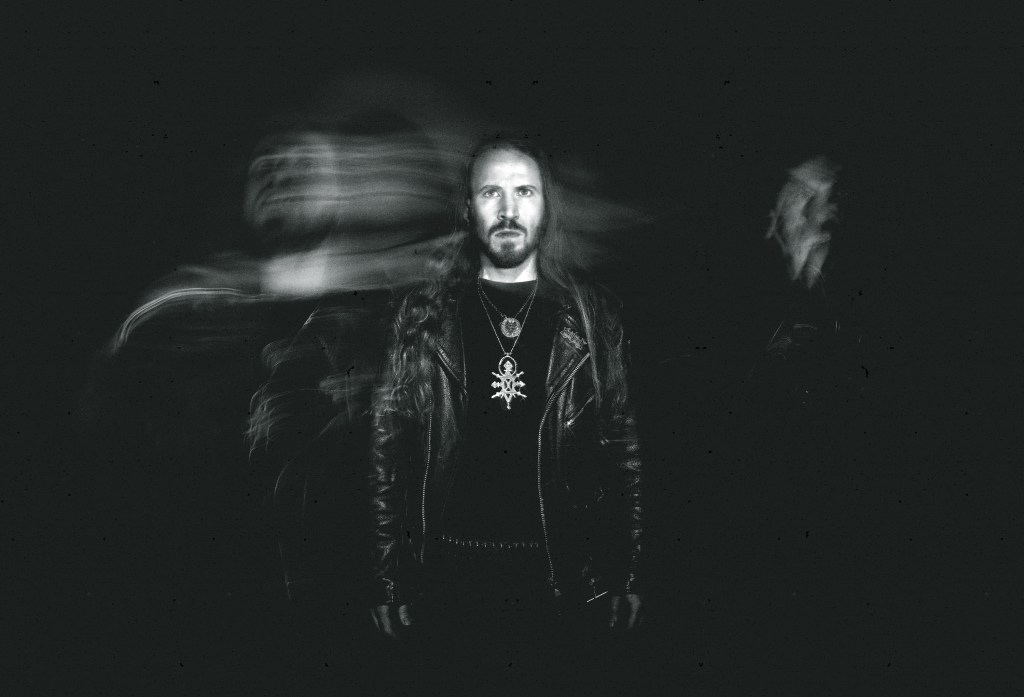
Necrowretch (Interview with Vlad – By D, July 2025)
Let’s get into it!
Best place to start is usually, in your own words, what is Necrowretch and how did this project come together back in 2008?
Greetings! As a teenager, I used to listen to classic bands like Death, Morbid Angel, Entombed and Bathory, so it was only natural that I started playing the guitar to create something similar. Although I never took any courses, I taught myself to play the instrument, and the first demo was very raw, with simple but catchy songwriting.
I managed to create my first home demo with a drum machine to try and find some local musicians to join the band. Thanks to the internet, I found two guys in late 2008 (drummer and bass player), and together we started rehearsing. The first real demo, ‘Rising from Purulence’, was released in 2009 in tape format only (re-edited in 2013 for the CD compilation ‘Bestial Rites’).
As a band that has continued to release excellent release after excellent release, how does the composition process look for you guys? As your sound has continued to evolve over the years, I wonder how you guys approach the songwriting process?
I usually write the whole song and then submit it to the other musicians for new ideas and additions. The song usually changes a lot between my initial idea and what we create together, but always in a positive way. I also write a lot of arpeggios and leads on the 12-string guitar before trying them on an electric guitar. If it sounds good acoustically, it will sound even better with distortion, but the opposite isn’t necessarily true. I also consider the vocal part directly when writing songs; otherwise, you might end up with a good song that has no place for vocals, and vocals are an important part of Necrowretch’s identity.
Leading on from that, I’m always interested in what equipment people are using to make their sounds? And, is there any equipment you’d like to add to your arsenal moving forward?
The configuration isn’t the same for live and studio recordings, especially for amps and drum kits.
The following gear was used to record Swords of Dajjal:
Drums : Pearl Master custom 22×18, 10×9, 12×10, 13×11, 14×14
Drums heads Evan ec2
Snare : Tama starclassic 14×5.5
Cymbals : a mix of sabian / aax / zildjian avedis/k
Guitars : LTD Black metal / mics : Fishman Fluence
Aria Explorer / mics : Fishman Fluence
Strings : Ernie Ball cobalt 11-49 and 10-46
Amps : Mesaboogie triple rectifier + Marshall JCM 800
Cabs : Orange
Bass : Tobias Growler / Killer B
Additional instruments : Ibanez acoustic 12 strings guitar
Danelectro Bariton guitar
Konga percussion
For live performances, it’s basically the same guitars, but with different amps depending on the venue, or with a pedalboard directly connected.
In the future, we would love to include two spare guitars, a guitar technician, dancers and strippers, and a private jet. But for now, we’ll be fine with spare guitars (laughs).
Swords of Dajjal was excellent, I really enjoyed this release. I also enjoyed the Middle Eastern themes of the album. The Middle Eastern concepts seem to be a newer direction for the band. Was there any inspiration for this? Is there any literature that helped inspire the lyrics on this album?
Actually, it had always been on my mind, but there was never a good time or musicians who wanted to follow me in this direction. After the pandemic, the line-up changed, and it was the right moment to pursue this idea. I was also playing a lot with a 12-string guitar at this time, and the Diablo II remaster was the perfect opportunity to delve into the Middle Eastern nightmare once again.
My main inspiration came from some Islamic Sufi myths and legends. I spent some time reimagining them in a black metal style. There are also some other songs connected to the fall of the Roman Empire. It’s such a vast topic that it could fill an entire album.
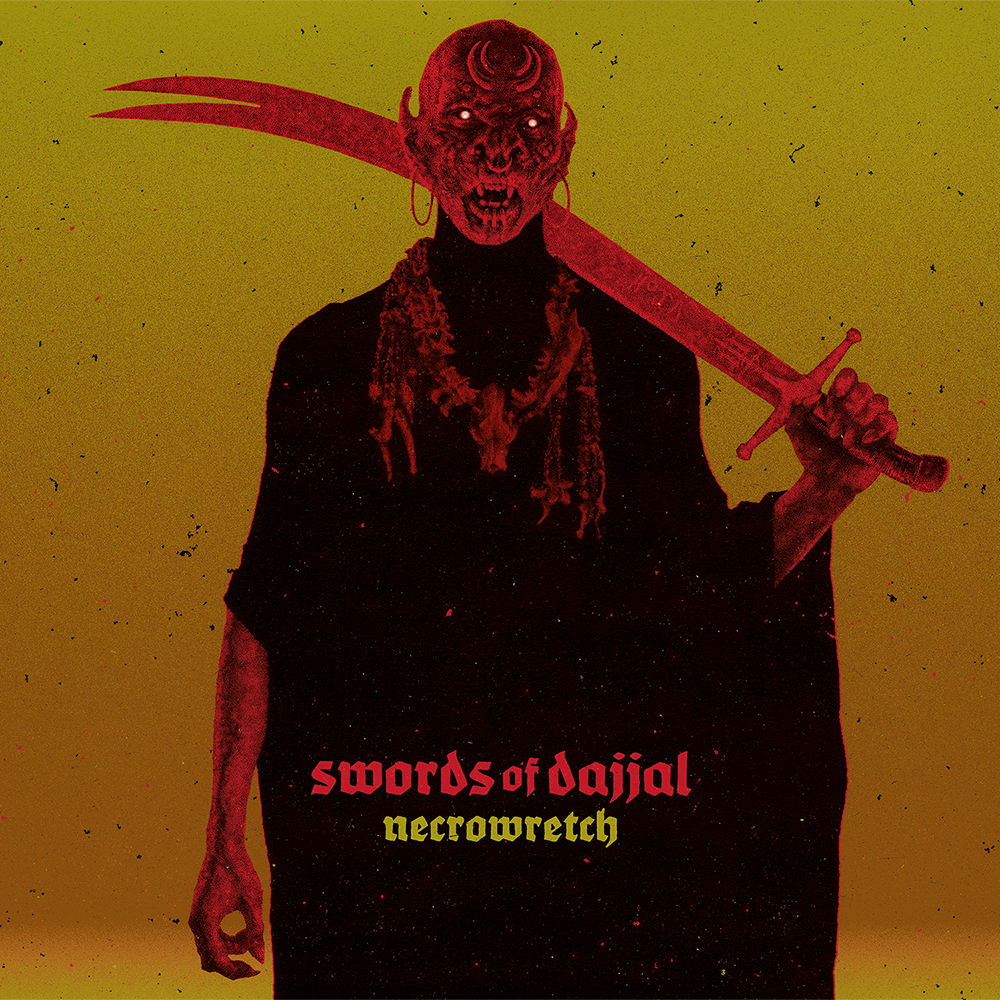
Let’s talk about the stunning artwork by Manifest for 2024’s Swords of Dajjal, as it is one of the best album covers I have seen in recent years. Everything about it just works – from the colour scheme, to the representation of Al-Masih ad-Dajjal itself – everything about this image is striking. It immediately captures your attention with the yellow, red, and black colour scheme, and the excellent placement of those colours to draw your eyes into the blackness after being captivated by the yellow background and the red-faced Dajjal. Was there any inspiration behind this image?
For the artwork, we collaborated once again with French artist Stefan Thanneur, who also created the visuals for our previous album, The Ones From Hell. We only reached out to him after the album had been fully mixed and mastered, as it was essential for us that he experience the music in its final form and let it inspire his artistic vision.
When we received the finished artwork, it perfectly captured what we had envisioned: a demonic prophet wielding a sword, rendered in a striking red-and-gold palette—evoking a mood somewhere between Dune and Diablo II.
Above all, it was crucial for both us and Stefan that the artwork stand out—whether seen online or in a record store. Its enigmatic presence is impossible to ignore, and we believe it naturally sparks curiosity and draws listeners into the music.
Following on from that, the production on Swords of Dajjal is also excellent. It’s crushing but there’s a level of clarity that I’ve found very impressive given the intensity of the work itself. How did you find working with Francis Caste / Studio Sainte-Marthe? Personally, I was very impressed with the production on tracks like The Fifth Door and Numidian Knowledge in particular, as it features sounds not typically present in the genre but they have been expertly blended into the mix.
To keep it short: Nicolas had already joined us for a few live sessions years ago, so when it came time to rework the lineup, the choice was obvious—he was the perfect fit.
In extreme metal, drums are absolutely foundational. A skilled drummer isn’t just important— it’s essential to the very foundation of the music.
With Nicolas on board, we moved away from rigid, preset tempos like “140” or “180 BPM.” Instead, we took the time to explore each track’s natural pace and groove, finding that sweet spot where every musician could lock in and create a true sense of osmose.
As a result, we slowed down certain riffs, sped others up, and ultimately shaped the dynamics in a way that reflects the raw energy of a live performance.
After two years of writing, countless demos, and intense rehearsals, we entered Studio Sainte Marthe in Paris in late 2022, spending five weeks there to bring the album to life.
Francis Caste has enjoyed a significant degree of popularity over the past two decades, with hundreds of productions. In this instance, the primary objective was to facilitate the transition from an underground to a professional sound, guided by a producer with the capacity to provide comprehensive guidance throughout the entire process.
In the studio, we pushed the drums to the forefront of the mix and used heavy reverb on the toms, along with wide panning, to immerse the listener—almost as if you’re sitting behind the kit yourself. It’s an unconventional choice, especially by today’s standards, but one that felt right for the record.
We also introduced conga percussion in select moments, adding an earthy low-end resonance and bringing a subtle oriental flavor to the overall soundscape.
As a band that has been around for almost two decades, what changes have you noticed in the metal scene within that time? Both at home in France, and more generally abroad?
Back then, reaching an audience beyond your own city or region wasn’t easy. You had to print flyers by hand, travel to other towns, play in rough underground venues, and build a network just to get your band’s name out there.
Today, a band can seemingly appear out of nowhere and rack up thousands of streams overnight—with the right promotion and a bit of ad money.
But the issue is, strong promotion doesn’t necessarily mean strong music. Metal, at its core, has always been about passion and authenticity—not about chasing streams or selling merch.
Personally, I’d much rather listen to an underground band that plays the kind of music I truly connect with than follow whatever’s trending just because it’s everywhere on social media.
That said, there’s a reason why so many albums from the ’80s and ’90s are still considered untouchable classics. Though, I’d argue that in the past decade, France has truly stepped up—with some of the best releases in the genre coming from French bands.
We’re a big fan of occult literature here at Mithraic Magazine. With that in mind, what are some occult, esoteric, or just interesting literature you would recommend your fans to read?
The following examples may be considered: Le Horla, Alamut, Call of Cthulhu, The Twelve Caesars, One Thousand and One Nights.
We’ve already covered the occult stuff, but it’s always good to ask, if there’s anything in general that Necrowretch believes we should be paying attention to?
Absolutely. In a time where it’s easier than ever to gain visibility through ads and algorithms, I think it’s important to pay attention to what drives the music—not just how it’s presented.
We don’t work within any industry bubble. We create music in our free time, outside of our full-time careers. This isn’t about money for us—and that’s something that still defines extreme metal: sincerity, honesty, and doing it for the love of the music.
I believe the most powerful albums in the genre were made by musicians playing with urgency and passion, like it was the last day of their lives. On the flip side, some of the weakest records come from those just going through the motions to pay the bills or please an audience.
So yeah—pay attention to what’s real. The intent behind the music matters just as much as the sound itself.
What is one of life’s mysteries that fascinates you?
One of life’s greatest mysteries, to me, is religion. We have no concrete proof that any gods have ever existed, and yet throughout history, humanity has lived, built, worshipped, and even gone to war in their name.
It fascinates me how entire civilizations have been shaped by belief—how something invisible can inspire such devotion, structure entire societies, and at the same time, justify destruction and violence. Whether or not any god exists, the impact of belief alone is undeniable—and that mystery continues to echo through every age.
This paradox is a never-ending source of inspiration for black metal, which thrives on exploring the dark and complex relationship between faith, power, and human nature.
Looking at your top 5 Spotify listeners by region, we see metal-loving staples like Sweden, Finland, Germany, and Poland. However, at least at the time of writing, your top listeners seem to be from Lithuania – I found that interesting as it’s a little different (Lithuania being a small country and with few metal bands compared to the other 4 countries I mentioned) – so I wanted to ask, outside of France, who has been the most receptive to Necrowretch’s music? Which country turns out in force when you play there live? And, is there any particular country that when you’re booked for gigs you’re all thinking, “fuck yes, let’s go!”?
For Lithuania : Its just that we played a festival there weeks ago (Kilkim Zaibu festival), so if the streams are up I guess the show was good enough ! (laughs).
Over the past decade, we had the incredible opportunity to tour Asia three times, performing in countries like Singapore, China, Korea, the Philippines, Taiwan, Malaysia, and Thailand. Each tour was a unique and eye-opening experience that left a lasting impression on us.
What stood out most was the youthfulness and passion of the audiences. Many of the fans were very young, yet deeply devoted—not just to the live shows, but to the music itself. They showed a genuine appreciation for the artistry, often going beyond just listening by collecting physical albums and supporting bands in a way that felt both rare and inspiring in today’s digital age.
This dedication wasn’t just about fandom; it was a shared cultural enthusiasm for the genre that transcended language and geography. Seeing such commitment and love for extreme metal across diverse countries reinforced how music truly is a universal language, connecting people worldwide despite different backgrounds.
Touring Asia wasn’t just about performing—it was about experiencing this powerful connection firsthand, and it remains one of the most rewarding parts of our journey as musicians.

Out of all the songs you have released, do you have any favourites? And which are the songs in particular that people go nuts for when you start to play them live?
Maybe Ksar al Kufar because I have a personnal story with this song :
Once upon a time, I visited the city of Ksar Al-Kebir in Morocco and fell terribly ill. It felt like a Lovecraftian curse—an almost martyrdom, enduring a series of intense headhaches for days. Some locals believed I was afflicted by a djinn, though I suspect the real culprit was more earthly: the “kif.”
Ever since that experience, the idea of writing a song called Ksar Al Kufar—a dark, devilish reflection of that city—has lingered in my mind. It’s a place that doesn’t exist on any map, reachable only through dreams… or rather, nightmares.
When we began crafting the album with its oriental themes, I knew the moment had come to bring Ksar Al Kufar to life. In the end, it turned out so powerful that we made it the opening track of the album and a staple of our live performances.
A question I always like to ask is, what are some of the smaller French bands you believe deserve some recognition for their work? And the same question, but more generally, are there any other smaller bands (from anywhere) that you believe deserve some recognition too?
France : Hexecutor, Skelethal, Venefixion…
World : Exhumation (Indonesia), Succubus (Malaysia), In Twilight’s Embrace (Poland)
Lastly, what does the rest of 2025 have in store for Necrowretch? What’s in the plans?
Here are the next shows for 2025:
09/08 – Partysan – Germany
15/08 – Le Grillen, Colmar -France
21/08 – Stengade, Copenhague – Denmark
20/09 – Nox Occultum, Tilburg – Netherlands
03/10 – Metal Threat, Chicago – USA
15/11 – Metalearth, Brest – France
And finally, anything you’d like to say or mention before we finish today?
Thank you for the interview, and a huge thanks to everyone who has supported Necrowretch over the past 15 years.
Stay tuned—and prepare yourself for some truly horrible doom!
Thanks again for your time today!
HTBLOF,
D
And there we go, direct from Necrowretch themselves.
As with every release, Necrowretch leaves behind a trail of scorched souls in its wake and leaves blasphemous echoes to reverberate around your cerebral cortex. From the depths of France’s darkest crypts, they summon chaos and obliteration with every riff. If you’ve not listened to Swords of Dajjal already, fix your own blasphemy and rectify this error now!
Swords of Dajjal was released via Season of Mist Underground Activists. If you like it (and can afford it) – buy it!
Links:
Homepage
Bandcamp
Facebook
Instagram
Season of Mist
Spotify



Leave a Reply