Today we are talking with a band that embodies the spirit of black metal in a way that was authentic to the time it was created, and rarely exists today. A band that has existed since 1997 but are so underground that their early demos aren’t (at the time of writing) even listed on their Metal Archives page.
Rising from the shadowed margins of the Finnish underground, Thiudareiks embody a vision of the genre that is both ancient in spirit and resolutely uncompromising. Their music moves with the weight of forgotten epochs in a grim, martial, and solemn manner. Guitars carve bleak, winding paths through thick fuzz, while rhythms thunder with an almost ritualistic resolve.
This is black metal not as spectacle, but as proclamation: severe, contemplative, and charged with an aura of authenticity that we have not seen much since the 90s.
Today we’re speaking with Rigurwothis Rex about the project’s mysterious omnipresence, the undocumented early years, and why the band decided to commit music to tape once again after a multi-decade hiatus from releasing records.
Appreciate your time today, R.R.!
I always like to start these things by asking, in your own words, what is Thiudareiks and how did this project begin back in 1997? Also, let’s talk about the name, is it from the Visigoth rulers, and was there any reason for why it was selected to represent the project?
First of all: thank you for having us and thanks for asking! Thiudareiks was started, when I met our drummer Sargatanas at a musical event in Helsinki in early 1997 shortly after moving to Finland from Germany, where I grew up. We got along with each other very well right away, discovering shared musical interests and more. So it was only a natural step that we decided to jam together in Sargatanas’ former band’s rehearsal room. Right from the start we felt a special kind of spark when we were playing together, like pieces from a puzzle finding each other, or spirits set free while being immersed in a space of sound that surrounded us. Quite soon we decided to form a band and after recruiting Marwolaeth on the bass, the initial incarnation of Thiudareiks took shape.
Speaking about our band’s name, you are on the right track referring to Gothic rulers. In actual fact ‘Thiudareiks’ is the Gothic language and means something like ‘ruler of the people’. It is the Gothic name of the Ostrogothic king ‘Theoderic the Great’, who established an Ostrogothic kingdom in Italy shortly after the collapse of the Western Roman Empire. This chaotic epoch in European history with all its turmoil, the migration period, and the figure of Theoderic especially were always fascinating to me. On the one hand, Theoderic was an ambitious and ruthless barbarian warlord with blood on his hands who was ready to fight and kill for his goals without hesitation. On the other hand he also laid the foundations for a period of decades of peace and prosperity in Europe during his rule through farsighted and skilful politics. Therefore he was described as a just and fair-minded king by his contemporaries. I always saw that historical figure with its contradictory nature as a metaphor for the ambiguousness of life and the state of our human existence, caught in this weird web of opposites that our being consists of. So, shortly said, I figured Thiudareiks would be a perfect name for an extreme metal band since my early teenage-years already and when I suggested that name to Sargatanas at the beginning of our journey, he was fond of the idea.
Then let’s talk about Thiudareiks’ mysterious omnipresence. What years have Thiudareiks actually been active as a project? As best as I can tell, there were a couple of early demos, and an appearance on a compilation album in 2005, but otherwise it seems to be mostly radio silence – bar the occasional show or two – for almost the next 20 years! What was going on behind the scenes during this time, was there any philosophy that dictated the band’s attitude towards performing and releasing music, or was it just a case of life getting in the way for a while?
Well, after starting out in 1997, we were more or less actively playing together until 2001. I moved to Tampere in 1998 which made it a bit difficult for us to rehearse regularly because of the distance to the rehearsal place in Helsinki and all kinds of profane obligations of life. In 1999, we were joined by another bassist and in early 2000 we recorded a four-track demo in Helsinki. The title of the demo was supposed to be “Rex”. However, we were really inexperienced and naive at the time, so we didn’t quite achieve the results we expected to get with that studio-recording. Therefore we decided to re-record the songs at a later point and release them when we would be satisfied with the result. As life goes, us all getting involved in other musical projects, studies, work, relationships, starting families, etc, got in the way and our plans for re-recording the demo never took place. We were kind of ahead of our time, one could say (with a blink in the eye), as we published the material somehow ‘digitally’ by sending mp3’s of the songs to some of our contacts and later on as streaming versions on our own website we were operating for a short period of time. We got encouraging feedback from our friends and peers, but no so-called ‘professional’ was interested in us. One of the demo session’s songs was later published on a German compilation called ‘Beyond Unknown” (Ubooks, 2005). Besides that demo-recording from 2000, we recorded tons of rehearsal tapes during our early years. Unfortunately lots of these gems got lost during some of my countless operations of moving flats, but a collection of early tapes has also survived. We haven’t uploaded any of these recordings on YouTube etc, as we see those tapes more as some artefacts of nostalgia for ourselves.
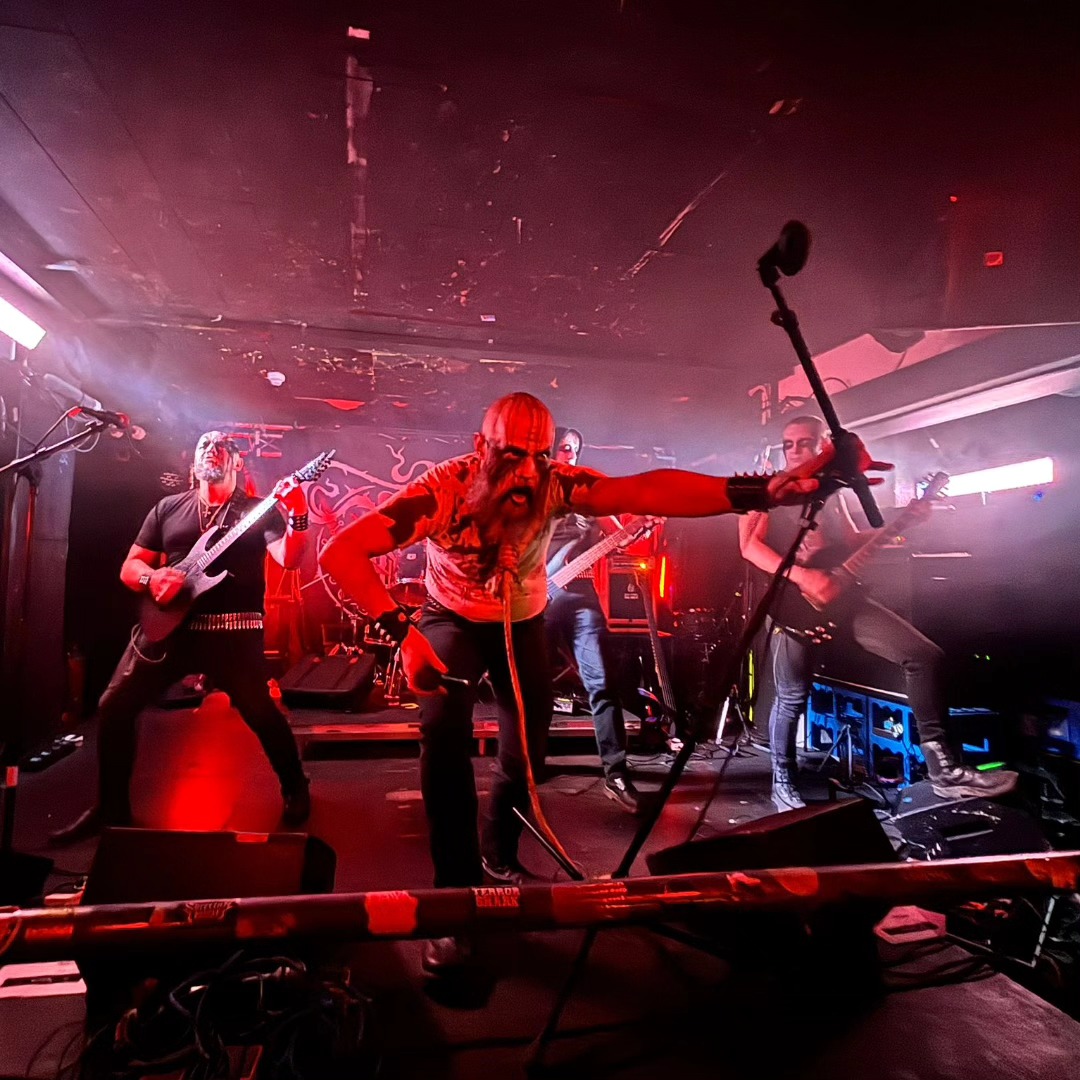
From 1997 to 2001 we also had a few live appearances. We made a short attempt to reanimate the band between 2003 and 2005 with a four piece line-up, which was actually full of potential. At that time I also designed the final version of the Thiudareiks logo (I’ve been drawing countless drafts for it over the years). We had our aforementioned homepage established at that time and big plans, however, life got us into its firm grip again… In 2012 a friend of ours, Petri Hamppinen, the bassist of Volymian, organized a band event in southern Finland and invited us to play a warm-up gig there. So in late 2011 we started to rehearse some of our old material together with our original bassist Marwolaeth again, who stayed in the band ever since. The gig was great fun to play, but life was still very busy, so we were quite passive about Thiudareiks again for many years. Over the course of time we gathered a great deal of musical material and we decided it would be time to record some of the stuff we had been working on in 2019. That same year we recruited Balaur Necurat on the vocals, who had a short intermezzo with Thiudareiks already roughly a decade earlier. We also returned to play live the following year. We decided to start recording with our original demo songs. Therefore we made plans to enter the studio in 2020. Of course, that must have caused a worldwide pandemic, *hargh*, and our recording sessions took a little longer than expected, because we had to take some extensive breaks during the lockdown. But after all those years a few months more or less didn’t really matter to us anymore. We started the project in late 2020 and finished it at the end of 2021, with the release happening finally in 2022. We decided to skip the demo-phase at this point and self-released the material as an EP (“Of Entering the Endless Plains”). After the release of the EP we started to work on our album “Tyrant of the Raven Throne”, which we recorded in 2024 and released in 2025 via Thundra Records (CD, MC, LP) and digitally independently, while playing live shows quite regularly lately. In 2025 we also recruited a second guitarist, Frawaurhtis Hairns to complete our line-up.
I would say, we didn’t really make a conscious choice to stay out of the public for that long time. However, we never felt the ultimate need to rush into the spotlight with what we were doing either. Our lives have often been guided by the need to prioritise and to be patient. Before releasing anything, we wanted Thiudareiks to represent our vision of what the band should sound like and to deliver quality material. We actually never consciously laid Thiudareiks on ice during all this time starting from 1997. Life often got in the way of Thiudareiks, but the backbone of the band was always the lasting friendship and companionship between me and Sargatanas and the drive to play our music. Also in our periods of hiatus we were coming together on an irregular basis and playing together. Often we were just the two of us jamming for hours in some underground-hole of a rehearsal room or in a cabin in the countryside. Of course we were dreaming about developing the band and bringing it to people’s consciousness one day, but that was never the main point of Thiudareiks. The most important thing was to make music together and to create our personal and intimate interpretation of black metal. Playing that music is one of the most cathartic experiences of my life and I think that was the flame that always kept burning, even though our story as a band isn’t probably the most typical one. I’m utterly grateful for being able to manifest Thiudareiks into physical form at this stage of life, being more experienced and balanced than in younger years. The whole life is a process and things need time to grow in order to get ready.
I know someone will be angry if I don’t ask next, do you remember any names of the early Thiudareiks releases, and what years they were released? Are their copies still in existence? It’s very rare to find a Metal Archives page where someone hasn’t tracked down every release a project has ever produced!
That one is very easy to answer, as you can see from my reply to the previous question: No one needs to get upset, because there aren’t actually any early releases, haha… 🙂 I’m still having the original master CD-R of our “Rex”-demorecording from 2000. But time has left its trace on that, so it stutters when being played. But no real release of that took place, apart from us sending some mp3’s here and there in 2000, maybe. I also own an original copy of the 2005 compilation “Beyond Unknown” featuring Thiudareiks. And then there is a collection of rehearsal tapes from 1997 to 2001. I sometimes think about going through them and extracting some old stuff to upload on YouTube or Soundcloud or maybe have a small edition of cassettes, but it obviously wasn’t the right time for such endeavours yet.
But back on track, what change occurred that allowed 2022’s Of Entering the Endless Plains and 2025’s Tyrant of the Raven Throne to happen?
For me it certainly was my kids entering an age that allowed me to get focused on my personal projects in life again, like doing music for instance. At the same time I felt that time was getting ripe for Thiudareiks. We’re not getting younger and we have lost friends and family members to death on our way. So in 2019 it was the strong notion of our live-spans being limited that made us push Thiudareiks forward. We still wanted Thiudareiks to burst into life before our personal journeys on this planet would come to an end.
Let’s talk about the latest release, Tyrant of the Raven Throne, which came out just at the end of 2025. How has the reception been so far? Have there been any exciting or interesting opportunities as a result of its release? And which countries have been showing the most appreciation for your work so far?
The reception has been positive and we’re quite content with it! We’ve got some great feedback from Poland, Germany and France, as well as from some instances here in Finland. I’m very happy to see that some people clearly understand and appreciate our approach to the genre. Others obviously don’t get easy access to our music, which is okay, because I don’t necessarily see us being a band to be to everybody’s liking. Our label is a small, independent Polish company (Thundra Records, a sub-label of Fluttering Dragon Records) with limited potential of promotion or helping organise tours or festival-appearances. However, the label does a great job within its capabilities and was a major help with the professional release of the album physically. Right now, Thundra Records is working on the release of the album on vinyl, which for me personally is a great satisfaction and a milestone as a musician. Some interesting opportunities for some live-activities in Finland are brewing up in the background, but there’s nothing to announce yet.
Let’s talk about the recording process. First of all, why now? Why after almost 30 years did you guys finally decide to commit to a full length album? I see the album was recorded at Studio Sound Louhos, was there any reason you chose this studio for your debut, and how was the experience? Also, it says the mixing was done by Marwolaeth, but I’ve not been able to find anything out about this individual. Who is this mysterious individual mastering your album, and how was the experience there as well?
That’s a valid question: why now? As we discussed, we’re not young anymore, so it was basically now or never! Time is limited and we had the wish to make an album with some of the material we had developed over the years. The decision to record at SoundLouhos was made because we know the studio’s owner Jani Autero. He is a sound engineer doing mainly live events. Black metal wise I’m not aware of him being utterly involved, except for an engagement with a release by Enochian Crescent back in the day. It was easy to make flexible arrangements regarding the recording sessions with him, which was a huge bonus for us. Our first EP was mixed and mastered by Jani at SoundLouhos and he also worked as sound engineer during drum-recordings of our EP already. So based on our previous cooperation it was an easy decision to record the whole album with him. The work in the studio was very straightforward and results-oriented. The recordings took place over several weekend sessions in the spring and early summer of 2024 and everyone was focused on their task. Everything went smoothly and it was a great experience. We also had a pretty clear idea of what we wanted to achieve, which made the work easier.
After the recordings, we had to deal with the fact that the mixing and mastering of the album was put on hold for almost six months, due to Jani’s occupation as a freelance sound-wizard. The mixing process dragged on for another three months, which is why we had to postpone the originally planned release at the end of 2024 indefinitely. The album was mixed and mastered by Jani as well, as was our 2022 EP. Marwolaeth, our bassist, worked as a sound engineer recording guitars, bass and vocals for that same EP, so maybe that’s why his name occurs in that mixing-context somehow. But he wasn’t responsible for mixing or mastering the album. Marwolaeth is an introvert Finnish guy who doesn’t feel much of a need to satisfy any kind of narcissism appearing publicly. Instead he concentrates on the essence of our music.
From that, let’s talk about the writing process. What does the composition look like for you guys? Is there a main songwriter, or is it always more of a group collaboration? How did you decide what riffs made it onto the recording, after 30 years in the making?
We’re not living very close to each other and it always takes some time and effort to agree on schedules for rehearsals. That’s why we usually work independently on sketches or drafts for new songs, with the main elements and structure more or less in place when we bring a song-idea to the rehearsal room to work on. During rehearsals we make adjustments to the arrangement, try different options and try to develop additional ideas for the songs. More often than not there also appear new ideas for the songs in the aftermath of our rehearsals. As we’re usually working at a very slow pace, most of the songs undergo in that way a process of metamorphosis over the course of some time, before they find their final form. Until now, it has been mainly me and Sargatanas contributing to the songwriting, regarding song-ideas, but each member of Thiudareiks contributes to his instrumental or vocal parts individually as well. The songwriting for the album was indeed a process going on for more than 25 years. The oldest riffs and fragments of arrangements are from the year 1997 and the youngest bits from around 2023. We tried to compose a coherent album, a unity and that was quite much the guideline which songs we chose to end up on “Tyrant of the Raven Throne”.
And I always like to know what equipment bands are using to record their sounds, which brands of instruments have been helping create the sounds of Thiudareiks? Is there any equipment you’d still like to add to your arsenal moving forward?
I’ve been using my good old Ibanez RG 470 with original INF2-mics for recording the main guitar tracks (rhythm and lead) of the album and a ESP LTD Black Metal with a Seymour Duncan Blackened Black Winter humbucker for the double tracking. The Ibanez is the same guitar I recorded the demo and the EP earlier on. The acoustic guitars were recorded with a Spanish Prudencio Saez 22. We were supposed to record the electric guitars on a Marshall JVM 410, but just when we started the recordings, the amp actually began to malfunction. So we had to switch to an EVH 5150 on the go. The cabinet in use was a Marshall 1960 412. The bass was recorded with an Ibanez Sound Gear axe and an Orange cabinet. For recording drums we used a Sonor set with Sabian cymbals, Steelcobra pedals and Vic Firth sticks. The mics used on the recording were a Sennheiser 900 series and Shure57s.
For my current live-rig, I usually play my ESP Black Metal and a pedalboard with a Friedman IR-X, UZI JOYO distortion, NUX Fireman distortion and Jessup TGW Morbid Tube overdrive-boost as heart pieces, supplemented by TU-3 tuner, Artec Graphic EQ, tc electronic SENTRY Noise Gate and Artec Analog Delay -pedals.
I might want to add a reverb pedal to my pedal board and maybe an expression pedal in the future, but I will see. I also like to try out different guitars and I would really like to add different axes to my setup. Maybe some Solar or Dean models with Fishman pickups. But accumulating a huge collection of gear is always a question of money and space to store all that stuff as well.
Let’s talk about the lyrical inspiration for this album. To me, the titles have an Edgar Allen-Poe, Lovecraftian, kind of feel to them, with titles like The Moors Receive What’s Theirs, Fertile Funeral Ground, and Necromaidian Flesh, as examples. So feels like a good question to ask, what inspired the lyrical content on the album?
A strong source of inspiration for me is the personal experience of the limitations of human existence and profane individual circumstances. Transience and death as well as accepting the absurdity and insignificance of existence, life as constant struggle, overcoming obstacles, and liberation from toxic belief patterns, many of them rooting in my Christian upbringing, are central themes in my lyrics. Writing lyrics is a way for dealing with the chaos in one’s mind and with emotional unrest in this life of uncertainty, offering meaning, purpose and a way to mentally break free. Another key source of inspiration is the experience of nature: a certain connection to being, to one’s roots, a kind of earthiness. In addition to that I feel an inherent fascination with the transcendent, the dark, the mysterious, the occult, and the primitive, the world of instincts. Of course I am also very much inspired by books I read, albums I listen to or different forms of visual art I expose myself to regularly. I often feel a great sense of excitement dealing with or facing works of art that resonate strongly with me and pluck some strings in my soul, so to speak. Important influences for me are a broad canon of international literature, Germanic and Norse mythology, paganism, European history, but also philosophical tendencies, such as Indian philosophy or existentialism. The topics I address in my lyrics, such as rituals, the overnatural, war, mythology etc., are metaphors for personal experiences, philosophies, and interests.
The lyrics as independent texts give listeners space for their own interpretation. They stand on their own, regardless of what we are trying to express with them. Every listener or reader is challenged to reflect on the personal resonance each text evokes. Nevertheless, I would like to give a short insight into some of the the motivations behind the lyrics:
The title of the intro, “Raven,” alludes to both the ravens Hugin and Munin from Norse mythology and references Theodoric, the “Raven King”, whose residence was in Ravenna, Italy. The raven symbolizes wisdom and knowledge, which we strive for. “The Moors Receive What’s Theirs” addresses the mystery of the bog bodies from Northern Europe, which are often suspected of being human sacrifices. The lyrics describe the blurring of the real and the supernatural in the course of a fictional pagan blood ritual. In Finland, we are surrounded by many bogs and marshes, which is why these landscapes are particularly dear to us. We can easily understand why people of bygone eras considered these places sacred and gateways to the supernatural. The idea of sacrifice also illustrates for us the fact that, on a personal level, one often has to make sacrifices to achieve one’s goals in life. One interpretation of “A Throne For You” is a journey into the subconscious of the dying King Theoderic, who, facing death, is forced to confront his own mortality and the transience of his hard-won life’s work. To build his kingdom and consolidate his power, the ruler sometimes had to stop at nothing. Until the very end, he struggles restlessly and tormentedly to justify some of his cruel actions to his inner self, trying to find means to secure his realm for his descendants, whose impending destruction he painfully senses. “Fertile Funeral Ground” deals with the theme of conflict and struggle on a personal level. The text addresses a destructive conflict, a war, that reveals the ugly face of humanity: hatred and unforgiveness leading to devastation. “Necromaidian Flesh” explores how one can become trapped in an ambivalent relationship of addiction and dependency. On the one hand, becoming absorbed in objects of desire leads to pleasure, liberating transgressions, and consciousness-expanding experiences; on the other hand, one becomes a slave to the constantly unfulfilled hunger for such experiences. This setup serves as a metaphor for addiction in general: be it to drugs, sex, social media, emotional intimacy, etc., from whose yoke one must break free. “Pre-Armageddic Death” is about how every person is exposed to unique life circumstances and can ultimately only trust themselves. It is futile to try to force things that one cannot influence. By accepting undesirable aspects of reality and letting go of unrealistic desires, one experiences, on the one hand, the death of a conception of oneself and the world. On the other hand, one can become aware of the true essence of things and thereby achieve consciousness – that is, liberation from hindering thought patterns and emotions. The lyrics of “Vae Victis” are directed against the detrimental nature of our modern way of life. This is characterized by greed, consumerism, and materialism, which we in Western Europe were conditioned to embrace after the World Wars and which lead us into unhealthy dependencies. We atrophy into a kind of will-less, indifferent, beaten slaves, easily manipulated. These modern circumstances are depicted through the story of the Ostrogoths’ historical defeat in their final battle at Mons Lactarius and the fatal consequences for the vanquished. However, as the text progresses and in the outro “Runes,” a fictional revolution and turning point occurs through the subjugated people’s return to their roots, their true identity and their gaining of wisdom by picking up the runes. So in the end it is about the individual’s challenge to break free from delusion (see the concept of Maya in Indian philosophy), regain consciousness, and reclaim authority over their own existence.
While we’re on the topic, we’re big fans of the arcane, esoteric, ancient, or occult over here at Mithraic Magazine. With those keywords in mind, is there any literature you can recommend? Either for your fans to discover more about any deeper meanings behind your work, or just in general for our fans as you think it’s interesting.
Given the keywords of your question, I strongly recommend you to discover the work of the Norwegian writer Maria Kvilhaug, if you aren’t aware of it yet. Kvilhaug is a historian of religions, philologist and artist, dealing with pre-Christian culture and the mythology of Scandinavia. In her nearly 700-page opus “The Seed of Yggdrasill” she delivers interpretations of the meaning of metaphors in Old Norse myths and Edda texts that really strongly resonate with me. “The Seed of Yggdrasill” is not only utterly interesting in elaborating etymological, cultural and historical aspects, but it also delivers keys to understand how Norse mythology actually makes deeper sense as philosophy. Kvilhaug’s book also makes clear how Norse mythology connects to our lives even today for its universal nature addressing general aspects of humanity, our environment and the state of existence. Following Kvilahaug’s approach of interpreting the ancient Norse texts, their whole mythological framework appears in a totally new light filled with life and gaining significance for us today. Apart from that, I think life is a mystery full of secrets. Maria Kvilhaug succeeds very well in showing how beautifully the ancient Scandinavian people were able to capture and embrace that aspect in their literature and mythology. I find diving into Kvilhaug’s work utterly inspiring, enlightening and fascinating. Besides “The Seed of Yggdrasill” she also has other publications about the topic and she has a YouTube channel, “Lady of the Labyrinth”, with lectures about Norse mythology that I encourage you to check out as well, if you are interested in the topic.
Besides Norse and Germanic mythology, being Finland-bound, it is inevitable that also the Finnish national Epic “Kalevala” by Elias Lönnrot has a major impact on us. This epic poem is omnipresent in many ways in Finnish cultural life and an outstanding work in the canon of Northern European mythology.
Speaking about the arcane, esoteric or occult, and as you mentioned Edgar Allan Poe and Lovecraft earlier, I have to say that I’m also a great fan of literature of the Romantic era, Gothic Fiction like “The Devil’s Elixirs” by E.T.A. Hoffmann, Emily Brontë’s “Wuthering Heights” or Theodor Storm’s “The Rider on the White Horse.” Another book that has left a lasting impression on me and that I want to mention therefore is the historical novel “The Odin Field” by Wilhelm Raabe dealing with the time of the Seven Year’s War (1756-63). I also like to read poetry, at times, by the likes of Wordsworth, Eichendorff, Rilke or Hesse, just to mention a few. Of course there is an abundance of literature worth mentioning out there, way too many to enlist in this context.
Outside of anything mentioned already, is there anything else Thiudareiks recommends we check out or pay attention to? (Note: this can be books, movies, events, festivals, whatever – but not music as this is next.)
I’m very much into historical novels and one outstanding example for that genre is Mika Waltari’s “The Egyptian” (Sinuhe Egyptiläinen). Not in vain this novel is considered a milestone of Finnish literature. When I was a teenager, I stumbled upon the historical novel “A Struggle for Rome” by Felix Dahn. That novel was actually the trigger for me being interested in Theoderic, the migration period, the downfall of the ancient world and early medieval history. I haven’t read it in ages, but back in the day the novel made a great impression on me. I mean, a quote like “Dietericus de Berne, de quo cantant rustici usque hodie” is epic! There is also a movie based on the novel, which was made in the 60ies. It’s probably quite out of date nowadays, as filmmaking and cinematographic effects have come a long way from that, but I remember enjoying it in the end of the eighties, when it was screened on TV. Right now I’m reading “Theoderic the Great: King of Goths, Ruler of Romans” by Hans-Ulrich Wiemer, which is an enjoyable yet sophisticated read about the history and biography of Theoderic and his epoch. Strong recommendation from my side, if you find any interest in the history of the migration period!
Besides Nordic and Finnish mythology, also Germanic heroic epic like the “Nibelungenlied” for example are a frequent source of inspiration for me.
Another thing I found very inspiring was the Gothic Modern exhibition which subsequently took place in Helsinki, Oslo and Vienna, coming to an end just at the beginning of this year. I was lucky to catch the actual exhibition at Ateneum Art Museum in Helsinki. Even though it is not possible to visit the exhibition itself anymore, I suggest you explore online material about the exhibition or accompaigning publications (e.g. “Gothic Modern: From Edvard Munch to Käthe Kollwitz”, Hirmer Publications). I saw the title “Gothic Modern I” somewhere, so maybe there will be a second edition one day. I hope so.
About festivals, there are a bunch of interesting events going on here in the Nordics and nearby in the Baltics. In Finland we’re having Steelfest of course, which is well worth a visit, if you’re around. An interesting new black metal festival of a smaller degree called “Heretical Fever Meeting” had its second edition last year. That’s an event I would like to check out myself one day, as well as “Howls of Winter” in Tallinn, Estonia. In autumn there is an annual event called “Pakanafestarit” (meaning pagan festival) in Espoo nearby Helsinki. That’s definitely something to check out as well. Besides music, they’re having workshops, performances, panel discussions, rituals, exhibitions and stuff like that for people interested in paganism and heathen ways of life.
I always like to ask, and outside of yourselves, who are some of the other underground bands that you think deserve some recognition for their contributions to the craft? Starting with Finland, but then also more globally – which bands do Thiudareiks believe deserves more recognition for their work?
Our drummer Sargatanas plays bass in a band called “Astral Corpse” – a great Finnish underground band well worth listening to. Our labelmates from “Saitma” were just releasing their first album at the same time as we on Thundra records. We had the pleasure to play a few times together with them. They play a kind of straightforward and brutal brand of black metal with a personal note I like very much and are a very strong live act. I also want to mention Nocturnal Exorcism, who are delivering an archaic, cult-like nordic style of black metal. I very much look forward to their new material that should be coming up this year. Another interesting Finnish act worth mentioning is “Essedum”. They have a more melodic, yet utterly brutal musical style and deal, among other topics, with Celtic mythology lyricwise, which makes them very interesting to me. Just recently I discovered a great local act called “Veret” from Tampere. Their music made a great impression on me, reminding me of old school versions of Sacramentum, Dissection and bands like that. There are really many outstanding bands in the Finnish underground, so the list deserving to be mentioned here is endless. Internationally I personally like the early albums of Helheim from Norway quite much. I don’t know how much one can consider them underground nowadays anymore, but they deserve more recognition if you want to know my humble opinion. An outstanding German underground black metal band is “Wintarnaht”. Their music is great and I love their concept of dealing with Germanic paganism, runes etc. while making use of Old High German language for their lyrics. “Ashtar” from Switzerland create fascinating black-doomish soundscapes, too. Immersive and mind blowing. An interesting Asian act is “Tetragrammacide”.
With my other band Beatrix, which is playing old school inspired blackthrash, we’re heading for the “Balto-Finnic Heresy Tour” from 23rd of February to 13th of March this year, doing eight shows in the Baltic countries and in Finland. The tour is headlined by the Lithuanian blackthrashers “Night Slasher” and we’re accompanied by the Finnish blackspeed-maniacs of “Jävelin”. All those bands are worthwhile to be discovered as well, I think.
You’ve obviously ended 2025 with the release of Tyrant of the Raven Throne but what does 2026 have in store for Thiudareiks? Any plans, any shows?
Once the vinyl version of the album is ready, we would like to finally organize some album release shows, but we have to wait for the LP-release schedule before booking the venues. Apart from that there are some plans for a show in my hometown in Tampere this spring and maybe an appearance at the Heretical Fever Meeting warm-up event this summer. More info on these can be expected in the upcoming weeks. We’re always up for playing live, so there definitely will be some gigs around Finland this year. If someone is willing to invite us abroad, we’re always ready to follow the call!
Besides planning live activities, we’re currently working on new material for a second album. Songwriting is proceeding well, so now we have to rehearse and arrange the material. We haven’t booked any studio yet, but I think recording won’t happen this year anymore. Furthermore, we’re probably going to expand our line-up with another guitarist, either for live situations or maybe even permanently, in order to have more flexibility. So there is some casting and experimenting going on behind the scenes.
Lastly, before I let you leave for today, is there anything you’d like to add or say before we finish today?
Thank you very much for the interesting questions and for featuring us! It was a great pleasure talking to you and to get the opportunity to share the story of Thiudareiks with you and the readers of Mithraic Magazine.
It struck my mind that different aspects of the expression “Gothic” obviously played a major part in this interview. Firstly “Gothic” as referring to the historical Goths and their language, secondly referring to a gloomy strain of literature and thirdly as a reference for late nineteenth-century and early twentieth-century art…
Anyways, I hope to see you guys some day on the road! Until then, take care!
– R.R.
~ unte:meina:ist:thiudangardi ~
Appreciate it, R.R.!
HTBLOF.
In a scene defined by its own history, Thiudareiks still stand apart by reaching further back than most into the sound, memory, and atmosphere of an era long extinguished. Their music is not merely an echo of black metal’s past, but a reminder that the genre still has the power to summon something ancient and unsettling sounds even after 3 decades of activity.
While steeped in history, Tyrant of the Raven Throne is still an album that is willing to take risks. While there is no doubt this is a black metal release, you will find Thiudareiks taking inspiration from multiple sounds and styles to give a familiar but fresh album that lingers in the memory long after it’s finished playing.
f you’re into how it was, especially in ethos and spirit, then you definitely want to check out Thiudareiks’s Tyrant of the Raven Throne as it is a project that embodies, and has lived through, the chaotic, frantic, and untamed nature of original second wave black metal and still carries its flame today.
If you’ve somehow not been convinced already to click on one of the links around the page, I highly recommend you reconsider where you click next as you’re missing out on some quality black metal if you don’t give this a listen before leaving. As always, if you like it and can afford to do so – you should definitely buy it!
 Mithraic Magazine
Leave a comment